
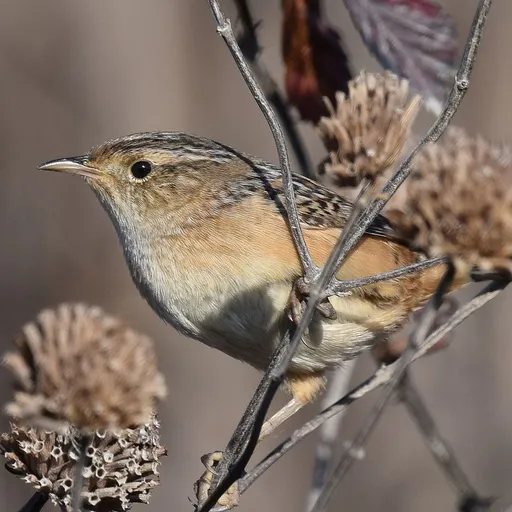
Sedge Wren
Cistothorus stellaris
Least Concern
Listen
XC960300 · Beth Cottam · Buffalo River State Park, Clay County, Minnesota, United States · CC0 1.0
Overview
The sedge wren, Cistothorus stellaris, is a small and secretive passerine bird widely distributed across North America. It is classified as Least Concern on the IUCN Red List and was formerly considered conspecific with the non-migratory grass wren of central and South America.
Identification
- Males and females share identical plumage, featuring a tawny brown head and back streaked with black and white, a pale buff supercilium, and brown irises.
- A white throat and belly, with pale buff on the sides, contrast with the orange rump and tawny brown tail banded with black.
- The bird possesses a long, slender beak with a brown upper mandible and yellow lower mandible, supported by pink legs and feet.
- Its song lasts 1.5 to 2 seconds, beginning with 3 to 4 high notes or staccato chips followed by a series of thrills.
Habitat
During the breeding season, the species occupies meadows and wet grasslands, extending to marshes and dry prairies where dense, tall grasses and sedges are available for nesting. In winter, migratory populations inhabit diverse environments such as pine savannas, meadows, and bogs, provided sufficient insects are present. Its range spans from southern Canada west of the Appalachians down to Texas and Florida in the winter.
Diet
Sedge wrens forage on the ground for insects and spiders, consuming species such as moths, flies, and grasshoppers.
Did you know?
Sedge wrens improvise their songs rather than learning them from others, a trait driven by their nomadic breeding habits and frequent population mixing. This results in individually unique song variations that allow birds from different regions to communicate despite not having precise templates.
Sources
- Wikipedia · CC BY-SA 4.0
- Wikidata · CC0 1.0