
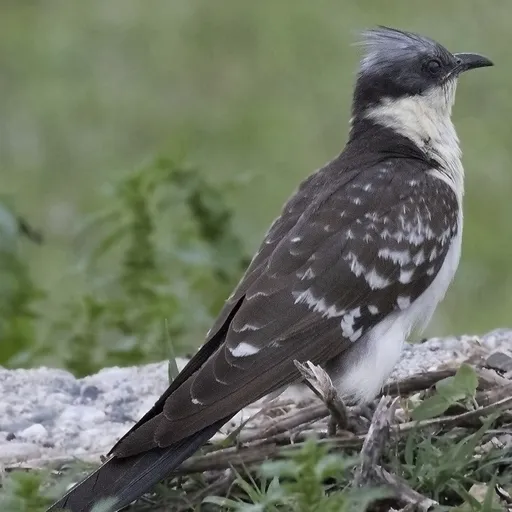
Great Spotted Cuckoo
Clamator glandarius
Least Concern
Listen
XC1107796 · Sonothèque ADVL · Genêts, Manche, Normandie, France · CC0 1.0
Overview
The great spotted cuckoo, Clamator glandarius, is a member of the cuckoo order, Cuculiformes, which also includes roadrunners, anis, and coucals. It is a brood parasite that lays its eggs in the nests of corvids, particularly the Eurasian magpie, rather than evicting host eggs as the common cuckoo does.
Identification
- Slightly larger than the common cuckoo, measuring 35–39 cm in length, with a slender body, broad wings, and a long, narrow tail.
- Adults feature a grey cap and upperparts, a yellowish face and upper breast, white underparts, and strong legs; juveniles have blackish upperparts, a blackish cap, and chestnut primary wing feathers.
- Displays a magpie-like flight pattern.
- Produces a loud call described as "cher-cher-kri-kri" with variations.
Habitat
Widely distributed throughout Africa and the Mediterranean Basin, this species inhabits warm, open country that contains trees.
Diet
The great spotted cuckoo feeds on insects, spiders, small reptiles, and hairy caterpillars, the latter of which are distasteful to many other birds.
Did you know?
Chicks of this species secrete a repellent scent when predators threaten, which protects not only themselves but also the host chicks, allowing carrion crow chicks to survive better in nests that include a great spotted cuckoo chick when predation pressure is high.
Sources
- Wikipedia · CC BY-SA 4.0
- Wikidata · CC0 1.0