
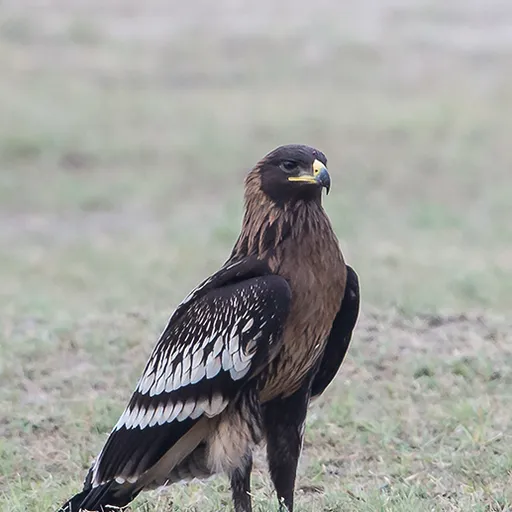
Greater Spotted Eagle
Clanga clanga
Vulnerable
Overview
The greater spotted eagle (Clanga clanga) is a large migratory bird of prey in the family Accipitridae, classified as Vulnerable on the IUCN Red List. It belongs to the subfamily Aquilinae, commonly known as booted eagles, and was previously classified within the genus Aquila.
Identification
- Plumage: Generally a uniform dark to blackish brown, which may appear purplish and glossy; some pale fulvescens phenotypes exist with bicolored plumage.
- Structure: Large and compact with a short neck, large shaggy-naped head, and a strong yellow beak; wings are broad and long, reaching the tail tip, while the tail is relatively short and rounded.
- Flight: In flight, the bird appears heavy-bodied and suspended below its wings with slightly bulging secondaries and squared primary tips; upperwings variably show a pale primary patch.
- Call: The most common call is a soft, high-pitched, urgent whistle transcribed as 'kyack' or 'dyip', which is slightly deeper and more ringing than that of the lesser spotted eagle.
Habitat
During the breeding season, the species is widely distributed across Eastern Europe, parts of Central Europe, central Russia, central Asia, and parts of China, favouring wetter habitats such as riparian zones, bogs, and floodplains. In winter, they migrate to South Asia, Southeast Asia, the Middle East, the upper Mediterranean Basin, and parts of East Africa, often seeking similar wetland habitats but sometimes utilising dry upland areas such as savanna plateaus.
Diet
The greater spotted eagle is an opportunistic forager that primarily hunts in the air by gliding from concealed perches over marshes or wet fields to catch prey. Its diet includes small mammals such as rodents, frogs, smaller birds especially waterfowl, and occasionally reptiles and insects, as well as scavenging carrion, particularly during the winter.
Did you know?
The species frequently breeds with its close relative, the lesser spotted eagle, forming hybrid offspring, a phenomenon that is detrimental to the population of the rarer greater spotted eagle.
Sources
- Wikipedia · CC BY-SA 4.0
- Wikidata · CC0 1.0