
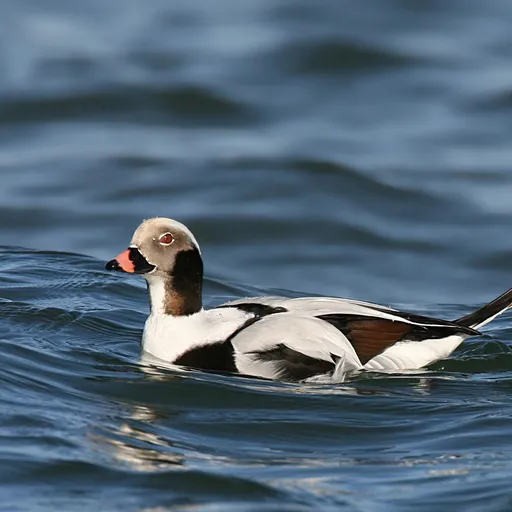
Long-tailed Duck
Clangula hyemalis
Vulnerable
Overview
The long-tailed duck (Clangula hyemalis) is a medium-sized sea duck that is the sole member of the genus Clangula. It breeds in the tundra and taiga regions of the Arctic and winters along the northern coastlines of the Atlantic and Pacific Oceans. The species is currently categorised as vulnerable by the IUCN Red List.
Identification
- Males possess a long, pointed tail measuring 10 to 15 cm, along with a dark grey bill crossed by a pink band.
- In winter, males exhibit a dark cheek patch on a mainly white head and neck, a dark breast, and a mostly white body.
- Females feature a brown back and a relatively short, pointed tail, with a white head and dark crown in winter.
- Males are vocal, producing a musical yodelling call described as 'ow, ow, owal-ow'.
Habitat
Breeding occurs in tundra pools, marshes, along sea coasts, and in large mountain lakes across northern Eurasia, the Faroe Islands, and parts of North America. In winter, the species inhabits large bodies of seawater including the Northern Pacific Ocean, North Atlantic Ocean, Hudson Bay, and the North American Great Lakes. Significant wintering populations gather in the Baltic Sea, while small numbers have been found on the Missouri River.
Diet
The long-tailed duck forages by diving for molluscs, crustaceans, and some small fish. Although they usually feed close to the surface, they are capable of diving to depths of 60 m, with some records suggesting depths up to 150 m. They use their wings to dive, similar to velvet scoters, which allows them to reach greater depths than most other ducks.
Did you know?
The name 'long-tailed duck' was formally adopted by the American Ornithologists' Union in 2000 to replace 'oldsquaw', a term considered potentially offensive to Native American tribes whose cooperation is vital for conservation efforts. The species is also known by the alternative names coween, south-southerly, and old wife.
Sources
- Wikipedia · CC BY-SA 4.0
- Wikidata · CC0 1.0