
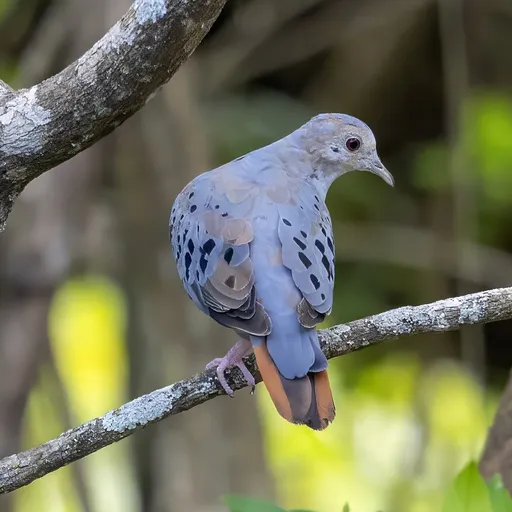
Blue Ground Dove
Claravis pretiosa
Least Concern
Overview
The blue ground dove (Claravis pretiosa) is a small New World tropical dove that serves as a resident breeder from southeastern Mexico to northwestern Peru, northern Argentina, and Trinidad. It is currently listed as Least Concern on the IUCN Red List.
Identification
- Adult males possess blue-grey upperparts and paler grey underparts, while the face is grey-white.
- Males feature blackish flight and outer tail feathers, with wings that are boldly spotted black, often forming distinct bands.
- Females have a grey-brown head, neck, and breast transitioning to pale blue-grey on the underwings and belly, with a ruddy brown back and chestnut rump.
- The male's song is a loud boop delivered from treetops.
Habitat
Relatively common in open woodland, forest edges, clearings, and roadsides, particularly in humid areas, the species ranges from sea level to approximately 1200 m altitude. It constructs a flimsy dish nest of twigs situated 1–11 m high in a tree.
Diet
Foraging mainly on the ground, blue ground doves consume seeds and small insects, along with grit. They are observed singly, in pairs, or occasionally in small groups.
Did you know?
The genus name Claravis combines the Latin words clarus, meaning 'distinct' or 'clear', with avis, meaning 'bird'.
Sources
- Wikipedia · CC BY-SA 4.0
- Wikidata · CC0 1.0