
Canebrake Groundcreeper
Clibanornis dendrocolaptoides
Least Concern
Overview
The canebrake groundcreeper (Clibanornis dendrocolaptoides) is a monotypic species of bird in the ovenbird family Furnariidae. It is classified as Least Concern by the IUCN Red List, though its population is believed to be decreasing due to habitat loss.
Identification
- Length of 20 to 22 cm with an estimated weight of 52 to 54 g.
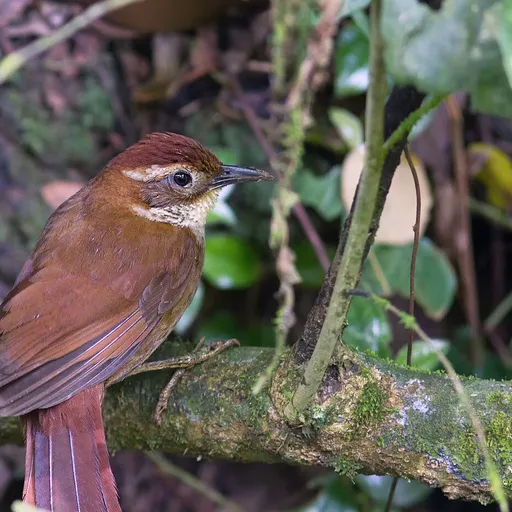
- Dull reddish brown face with dark brown lores, a dark chestnut-brown crown, and rufescent brown back and rump.
- White throat with blackish speckles on the sides, dull grayish breast and belly, and rufous-brown sides.
- Almost straight black bill and olive-green to greenish gray legs and feet.
- Song described as short to long series of loud staccato 'chet' notes, often interspersed with harsh chatters.
Habitat
Found in southeastern Brazil from São Paulo state south into Rio Grande do Sul, and in northeastern Argentina's Misiones Province. It inhabits montane and tropical lowland evergreen forest, favouring hilly terrain, forest edges, and secondary forest near watercourses. It is often associated with bamboo thickets and dense understory at elevations ranging from near sea level to 1,200 m.
Diet
The diet and foraging technique of the canebrake groundcreeper are largely unknown. It is usually seen in pairs in dense undergrowth and is assumed to glean arthropod prey on or near the ground.
Did you know?
The species was first assessed by the IUCN as Threatened in 1988, a status it held before being downlisted to Vulnerable, then Near Threatened, and finally to Least Concern in 2022 despite a continuing population decline.
Sources
- Wikipedia · CC BY-SA 4.0
- Wikidata · CC0 1.0