
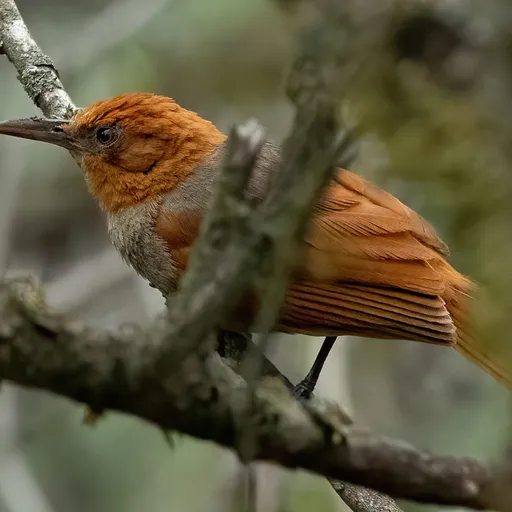
Henna-hooded Foliage-gleaner
Clibanornis erythrocephalus
Near Threatened
Listen
XC250369 · Niels Krabbe · Loja: Tambo Negro 10 km E Macará, Ecuador · CC BY-SA 4.0
Overview
The henna-hooded foliage-gleaner, Clibanornis erythrocephalus, is a Near Threatened species of bird belonging to the ovenbird family Furnariidae. It is a large, boldly-patterned species native to the Andean slopes of South America.
Identification
- Approximately 21 cm long and weighing around 48 g, it is a large bird with a thick, slightly decurved bill.
- The nominate subspecies features a unique henna (orange-rufous) head, neck, wings, and tail, contrasting with a brownish-olive back and pale brownish-gray underparts with a rufous crissum.
- Subspecies C. e. palamblae displays a paler rufous plumage, a grayer back, and a paler buff breast and belly.
- Its song is described as a far-carrying, persistent, staccato churring with an odd, mechanical-sounding quality, accompanied by a short, sharp, high-pitched call.
Habitat
This species inhabits deciduous and semihumid forests and woodlands, predominantly on the lower slopes of the western Andes. It shows a preference for areas rich in Malvaceae, the mallow family, and typically occurs between elevations of 400 and 1,800 m in Ecuador and 400 and 1,500 m in Peru. Its range spans parts of west-central and southern Ecuador, as well as the northwestern and northern Peruvian departments of Tumbes, Piura, and Lambayeque.
Diet
Though its diet has not been extensively studied, it appears to feed on terrestrial invertebrates, including isopods. The bird forages on and near the ground, often in pairs or as part of mixed-species flocks, by noisily flicking aside leaves and probing through leaf litter, dead foliage, and vine tangles.
Did you know?
During the breeding season between January and May, both adults work together to excavate a burrow in a shaded earthen bank, where they construct a nest of rootlets and fibres at the end of the tunnel.
Sources
- Wikipedia · CC BY-SA 4.0
- Wikidata · CC0 1.0