
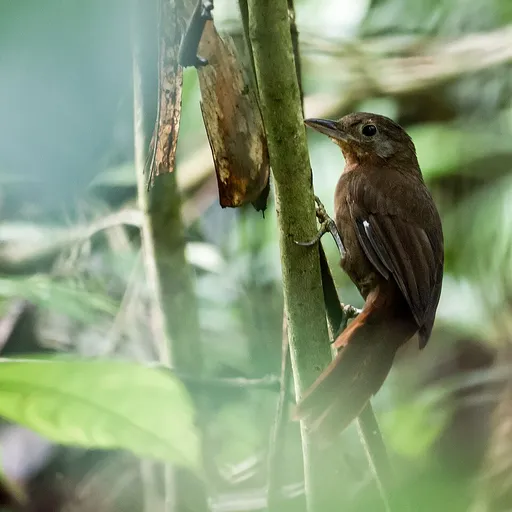
Ruddy Foliage-gleaner
Clibanornis rubiginosus
Least Concern
Listen
XC248264 · Niels Krabbe · Esmeraldas: 7 km WNW Lita, Ecuador · CC BY-SA 4.0
Overview
The ruddy foliage-gleaner, Clibanornis rubiginosus, is a species of bird in the ovenbird family Furnariidae. It is a year-round resident in most of its range and is currently assessed as being of Least Concern on the IUCN Red List.
Identification
- Adults of the nominate subspecies have a dark reddish-brown face with paler lores, a ring of bare blue skin around the eye, and a very dark brown crown with a reddish tone.
- The underparts are generally rufescent brown, with a dark rufous throat and a reddish brown breast that features faint paler spots along the feather shafts.
- The species measures 17 to 21.5 cm in length, with most subspecies weighing between 39 and 52 g.
- Vocalisations vary significantly by region, including a disyllabic nasal mewing in Mexico, a burry scratchy call in northern Central America, and a persistent upslurred call in the Andes.
Habitat
The ruddy foliage-gleaner has a highly disjunct distribution, found in Mexico, Central America, and most mainland South American countries except Argentina, Chile, Paraguay, and Uruguay. It inhabits humid evergreen, pine-evergreen, and pine-oak forests, cloud forests, and coffee plantations in Mexico and Central America, while in the Andes and Guianas it prefers lowland and foothill evergreen forests. The bird tends to stay in the forest understory and shows an affinity for the bottoms of ravines with dense vegetation.
Diet
The ruddy foliage-gleaner feeds on a variety of arthropods as well as small vertebrates such as frogs. It typically forages in pairs within the undergrowth or occasionally in the mid-storey, gleaned prey from dead leaves and decaying branches, and sometimes flips through leaf litter on the ground.
Did you know?
The species nests by constructing a cup of soft fibers inside a chamber at the end of a tunnel dug into an earthen bank.
Sources
- Wikipedia · CC BY-SA 4.0
- Wikidata · CC0 1.0