
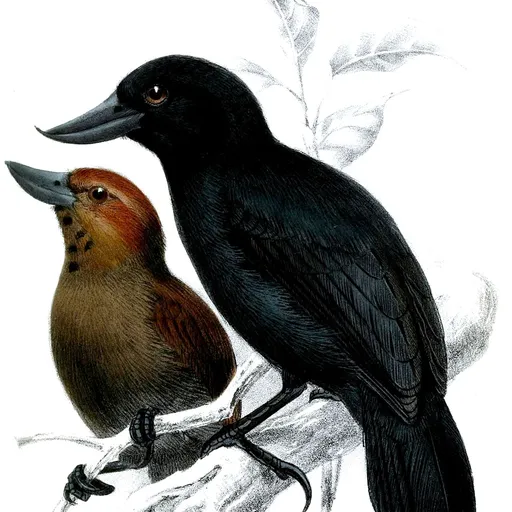
Recurve-billed Bushbird
Clytoctantes alixii
Endangered
Overview
The recurve-billed bushbird (Clytoctantes alixii) is an Endangered species of Thamnophilid antbird characterised by its extraordinary upward-curving bill. It is a year-round resident found in dense secondary vegetation and forest edges at the northern end of the Andes in Colombia and Venezuela.
Identification
- Size is 16 to 17 cm, featuring a stocky build and a short tail.
- The large, pale horn-coloured bill is laterally compressed with an upturned mandible.
- Adult males are generally dark grey with a white patch between the shoulders, black lores, throat, and upper breast centre, and small black spots on the wing coverts.
- Adult females have a dark rufous-brown crown, back, and rump, with blackish wings and tail tipped in pale rufous, and reddish-brown underparts.
- Vocalisation is a loud, mid-range whistling call described as "peeeuw peeeuw peeuw-pweet-pweet-pweet".
Habitat
Inhabits dense undergrowth in the understory and edges of evergreen forest, as well as clearings that are regenerating and nearby secondary forest, often associated with bamboo. Elevation ranges from 200 to 1,150 m in Colombia and 300 to 1,200 m in Venezuela, specifically within the Sierra de Perijá and parts of the Colombian departments of Antioquia, Norte de Santander, and Santander.
Diet
Feeds mostly on insects, seeking prey by pecking open and pulling strips from stems. It has been observed attending army ant swarms but is not known to join mixed-species feeding flocks.
Did you know?
Until 2007, the bird was almost unknown in life; apart from earlier specimens, it had only been seen alive once, at an army ant swarm in Colombia in 1965, before its rediscovery in 2004.
Sources
- Wikipedia · CC BY-SA 4.0
- Wikidata · CC0 1.0