
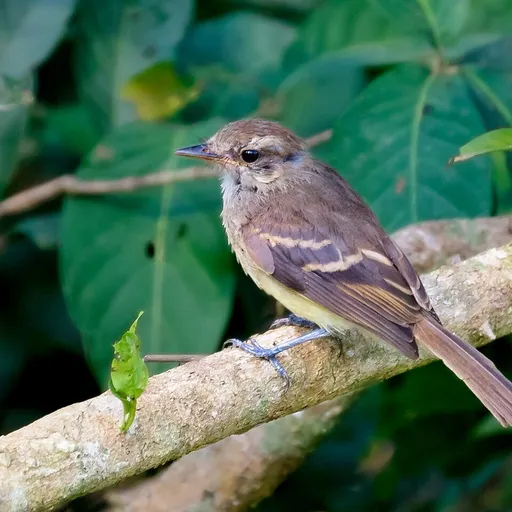
Fuscous Flycatcher
Cnemotriccus fuscatus
Least Concern
Overview
The fuscous flycatcher (Cnemotriccus fuscatus) is a small passerine bird in the family Tyrannidae, widely distributed across South America and the Caribbean. As the sole representative of its genus, it is assessed as Least Concern by the IUCN due to its extensive range, despite a suspected population decline.
Identification
- Length 13.5–15 cm; weight approx. 12 g; sexes are alike in plumage.
- Brown or rufescent upperparts; dusky lores with a whitish supercilium and eye-stripe.
- Dusky wings with two buffy wing bars; long, dusky tail with brown-edged feathers.
- White or pale-yellow throat; olive-grey to brownish breast; pale-yellow belly.
- Long, thin, blackish bill; dull pinkish or orange mandible base depending on subspecies; black legs.
Habitat
Inhabits a wide variety of landscapes in South America, Trinidad and Tobago, and isolated islands, favouring thick, shady undergrowth. Subspecies-specific preferences include humid forests and watercourses in C. f. fuscatior, nutrient-poor sandy forest in C. f. duidae, and drier woodlands or gallery forest in C. f. cabanisi. Altitudes range from sea level to 2,400 m, with most populations below 1,000 m.
Diet
Feeds primarily on insects, usually foraging alone or in pairs rather than in mixed-species flocks. Perches horizontally in dense vegetation up to about 3 m above the ground. Captures prey by making short sallies to snatch or hover-glean from foliage or the ground.
Did you know?
The species is likely a complex of two or more distinct species, but formal recognition awaits detailed taxonomic study of all taxa within Cnemotriccus fuscatus.
Sources
- Wikipedia · CC BY-SA 4.0
- Wikidata · CC0 1.0