
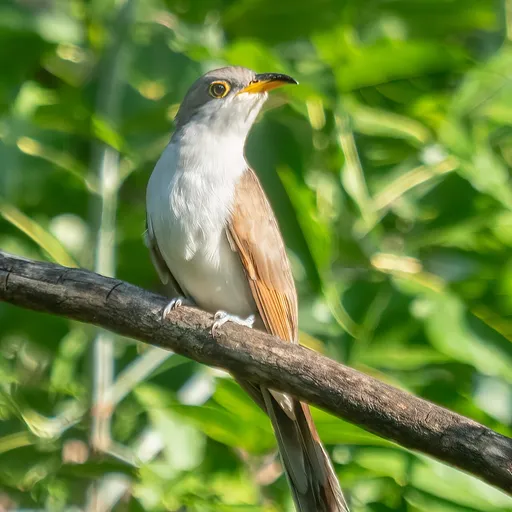
Yellow-billed Cuckoo
Coccyzus americanus
Least Concern
Overview
The yellow-billed cuckoo (Coccyzus americanus) is a member of the cuckoo family found in the Americas. Commonly known as the rain crow or storm crow in the southern United States, the species is currently classified as Least Concern on the IUCN Red List, although western populations have faced significant declines.
Identification
- Adults possess a long tail that is brown above and black-and-white below, with a black curved bill featuring yellow on the lower mandible.
- The head and upper body are brown, while the underparts are white, and a distinct yellow ring surrounds the eye.
- Measures approximately 26–30 cm in length with a wingspan of 38–43 cm, and cinnamon markings are visible on the wings during flight.
- Males and females are identical in plumage, showing no sexual dimorphism.
Habitat
Breeding habitats consist of deciduous woods ranging from southern Canada through Mexico and the Caribbean. These birds migrate to winter in Central America and as far south as northern Argentina, with rare vagrant records in western Europe.
Diet
Foraging occurs primarily in dense shrubs and trees, with the ability to catch insects in flight. Their diet consists mainly of insects such as tent caterpillars and cicadas, but also includes small lizards, bird eggs, and berries.
Did you know?
These birds are among the only species that undertake large-scale movements during the breeding season, with around 75 % of individuals travelling an average of 965 km between sites to exploit changing resource availability.
Sources
- Wikipedia · CC BY-SA 4.0
- Wikidata · CC0 1.0