
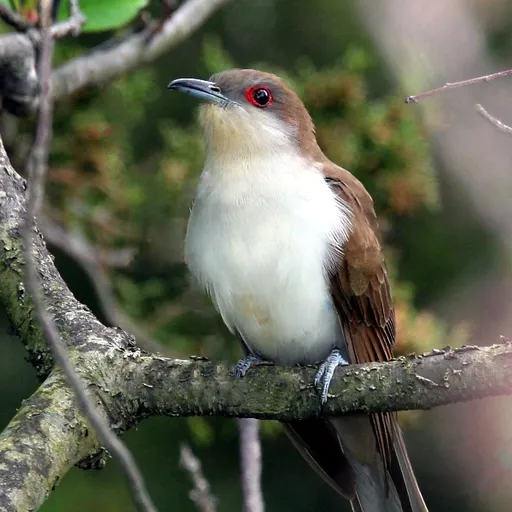
Black-billed Cuckoo
Coccyzus erythropthalmus
Least Concern
Listen
XC819701 · Jonathan Sowers · Skippack Township (near Collegeville), Montgomery County, Pennsylvania, United States · CC BY 4.0
Overview
The black-billed cuckoo (Coccyzus erythropthalmus) is a New World bird species belonging to the family Cuculidae. Unlike many members of its family, it is not an obligate brood parasite and often raises its own young. It is classified as Least Concern on the IUCN Red List, although its population is currently in decline.
Identification
- Long, graduated brown tail and a black, slightly downcurved bill.
- Brown head and upper parts contrasting with white underparts.
- Adults possess a narrow red orbital ring, while juveniles have a yellow ring and may show rufous colouration on the wings.
- Vocalisation consists of 2–5 sets of high-pitched, rapid 'coo' notes.
Habitat
Found across much of the United States east of the Rockies and in parts of southern and eastern Canada, wintering in northwestern South America. It favours mature deciduous or mixed forests, younger growth forests with thickets, and wetlands rich in alder and willow, but also inhabits open areas like golf courses and residential parks. A nearby water source such as a lake, river, or pond is typically required.
Diet
This species forages in shrubs and trees, primarily eating insects such as tent caterpillars and invasive spongy moths, as well as snails, eggs, and berries. It beats caterpillars against branches to remove indigestible hairs and then sheds its stomach lining to expel the accumulated hairs in a pellet. During insect outbreak years, cuckoos flock towards these areas, increasing local abundance.
Did you know?
When young black-billed cuckoo chicks feel threatened, they can assume an erect posture to conceal themselves by stretching their neck out and pointing their bill upwards while remaining motionless. Their chicks also possess complex, creamy-coloured structures on their mouth and tongue that may resemble warts or parasitic infections but are normal for the species.
Sources
- Wikipedia · CC BY-SA 4.0
- Wikidata · CC0 1.0