
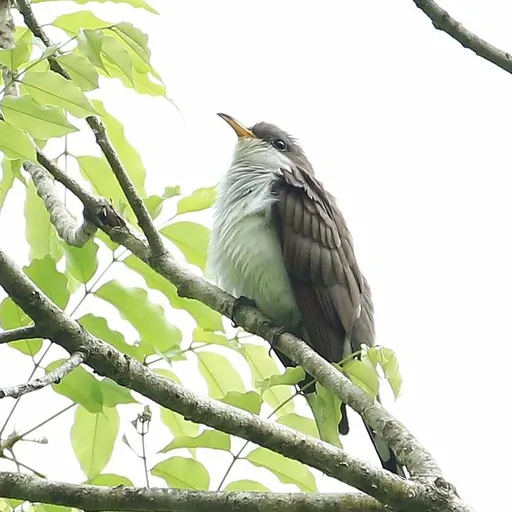
Pearly-breasted Cuckoo
Coccyzus euleri
Least Concern
Overview
The pearly-breasted cuckoo (Coccyzus euleri) is a species of bird in the cuckoo family Cuculidae. It is found across a wide range of South and Central American countries, including Argentina, Brazil, and Venezuela. The species is currently assessed as being of Least Concern on the IUCN Red List.
Identification
- Length is 25 to 28 cm, with the tail comprising about half of this length; males weigh 45–53 g and females 54–61 g.
- Upperparts are grayish brown with a light bronze gloss, while underparts are pearly grayish white on the throat and breast, white on the belly, and light pearly gray on the undertail coverts.
- Features a stout, somewhat decurved bill with a brown to black maxilla (yellow base) and a yellow to orange mandible (black tip).
- Face has a wide dark gray mask past the eye surrounded by a narrow ring of bare skin that is usually black but can be yellow or red.
- Primary song is a series of 5–15 loud, frog-like "kuoup" notes, also known as the "Kuoup Call".
Habitat
The species inhabits a very wide variety of landscapes, though most are wooded to some degree. Principal breeding habitats include humid evergreen primary forest, gallery forest, and secondary forest. It is found from Argentina and Brazil in the south to possibly Colombia and Panama in the north, typically at elevations below 900 m but recorded as high as 1,200 m.
Diet
The pearly-breasted cuckoo forages for invertebrate prey from the forest mid-story to the canopy. It feeds primarily on caterpillars. It is usually solitary but sometimes joins mixed-species foraging flocks.
Did you know?
For many years, the pearly-breasted cuckoo was confused with the yellow-billed cuckoo due to a specimen collected on Sombrero Island that was originally described as C. julieni, causing its taxonomic status to bounce between being a subspecies and a distinct species until 1992.
Sources
- Wikipedia · CC BY-SA 4.0
- Wikidata · CC0 1.0