
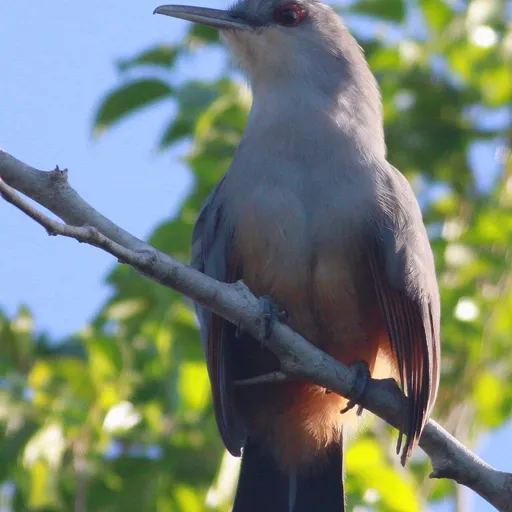
Hispaniolan Lizard Cuckoo
Coccyzus longirostris
Least Concern
Overview
The Hispaniolan lizard cuckoo (Coccyzus longirostris) is a bird species in the cuckoo family that is endemic to the Caribbean island of Hispaniola. It is generally considered to be of Least Concern by the IUCN, although its population is believed to be decreasing.
Identification
- 41 to 46 cm long, with a tail comprising about half its length.
- Adults of the nominate subspecies have entirely grey upperparts, chestnut wings with a rufous patch, a rufous throat and belly, and a black tail with large white tips on the underside.
- The subspecies C. l. petersi is paler overall than the nominate and has a whitish throat.
- Both sexes share the same plumage and possess a long, straight bill with a black maxilla and a paler mandible.
Habitat
The species is found in tropical deciduous and evergreen forests, open woodland, thickets, mountain slopes with bushes, plantations, and gardens across elevations from sea level to 2,200 m. The nominate subspecies occurs on the main island of Hispaniola and the offshore islands of Tortuga and Saona, while C. l. petersi is restricted to Gonâve Island off western Haiti.
Diet
This bird forages by walking along and among branches, typically from the middle to upper levels of the forest, though it also hunts near the ground. Its diet consists of lizards, small snakes, and various adult and larval insects, and it occasionally joins mixed-species feeding flocks.
Did you know?
Although it is generally widespread, the Hispaniolan lizard cuckoo is sometimes hunted in rural areas of Haiti to be used as a traditional digestive aid in medicine.
Sources
- Wikipedia · CC BY-SA 4.0
- Wikidata · CC0 1.0