
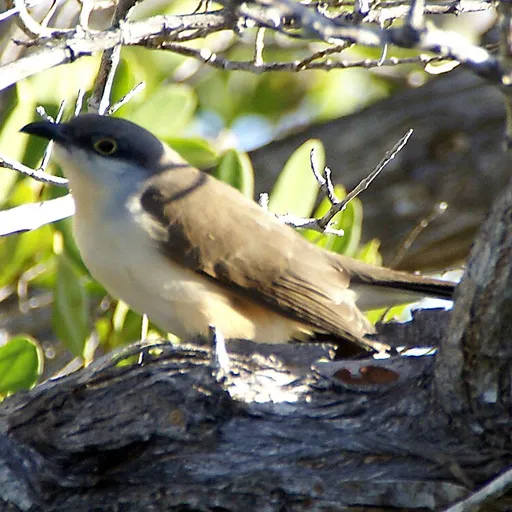
Dark-billed Cuckoo
Coccyzus melacoryphus
Least Concern
Overview
The dark-billed cuckoo is a species of bird in the cuckoo family, classified as Least Concern on the IUCN Red List. It is a fairly common resident or migrant across much of mainland South America, with the notable exception of Chile, as well as on the Galápagos Islands.
Identification
- Length of 25 to 28 cm, approximately half of which is the tail, with males weighing 42–54 g and females 50–66 g.
- Grey crown and nape, greyish-brown upperparts, and a wide black facial mask with an eye ring of citron, olive, or grey bare skin.
- Pale buff underparts with a slightly darker breast and grey sides; wings lack rufous tones.
- Distinctive vocalisations include 'six to eight resonant, buzzy kazoo-like notes' or a 'ventriloquial ga-ga-ga-go-go', alongside a 'dry-sounding buzz...dddddrr' call.
Habitat
This species inhabits a wide variety of landscapes including the interior and edges of tropical deciduous, gallery, and mature secondary forests, as well as mangroves. It is generally found in lowlands below 950 m but has been documented at elevations as high as 3,600 m.
Diet
The dark-billed cuckoo's diet consists almost entirely of insects, including both adult and larval forms.
Did you know?
In most of its range, the bird lays two or three eggs, but in Argentina the clutch size is more commonly three to four and occasionally reaches five.
Sources
- Wikipedia · CC BY-SA 4.0
- Wikidata · CC0 1.0