
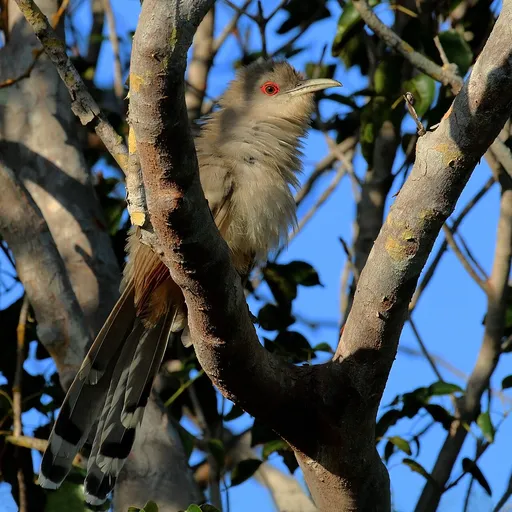
Great Lizard Cuckoo
Coccyzus merlini
Least Concern
Overview
The great lizard cuckoo (Coccyzus merlini) is the largest species within its genus. Native to the Bahamas and Cuba, it is classified as Least Concern by the IUCN, although the Bahama subspecies is considered Near Threatened.
Identification
- A large bird measuring 42 to 54 cm in length, with a long, almost straight bill featuring a black or dusky upper mandible and a paler lower mandible.
- The nominate subspecies displays an olive-brown upper body, rufous belly and undertail coverts, and a pale gray chest, with rufous flight feathers often visible only in flight.
- Adults possess red to orange bare skin around the eyes, while juveniles show yellow skin in the same area.
- Vocalisations include a 'Long Call' consisting of a throaty series of notes that increases in volume and speed, as well as a single emphatic 'Groan' followed by a low-pitched grating sound.
Habitat
Found in the Bahamas and Cuba, the species inhabits diverse landscapes such as mature and secondary forests, savannas, scrublands, and pine undergrowth, ranging in elevation from sea level to 1,250 m. The Bahama subspecies specifically occupies forests with vines, scrublands, and coffee plantations.
Diet
An opportunistic forager that primarily operates in the forest mid-story and canopy, though it also spends significant time on the ground. Its diet includes lizards, insects, nestling birds, frogs, snakes, and occasionally small mammals, seeds, or fruits.
Did you know?
The species is sedentary and is named for its diet, which includes lizards, alongside other vertebrates such as frogs and snakes.
Sources
- Wikipedia · CC BY-SA 4.0
- Wikidata · CC0 1.0