
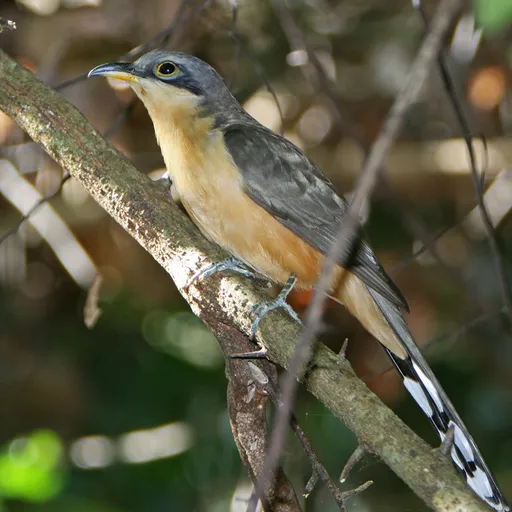
Mangrove Cuckoo
Coccyzus minor
Least Concern
Overview
The mangrove cuckoo (Coccyzus minor) is a species of cuckoo native to the Neotropics and currently classified as Least Concern on the IUCN Red List. Although its scientific name suggests it is small, it is actually the largest of North America's three Coccyzus cuckoos. It is a monotypic species with no recognised subspecies.
Identification
- Size: Adults measure 28–34 cm in length and weigh 64–102 g.
- Plumage: Brown head and upper parts with a black facial mask and buffy underparts; a long tail that is brown above and black-and-white below.
- Bill: Black and curved, with yellow on the lower mandible.
- Sound: The most common call is a guttural "gawk gawk gawk gawk gauk gauk", accompanied by a single "whit".
Habitat
This species resides in southern Florida, the Caribbean, both coasts of Mexico and Central America, and the Atlantic coast of South America as far south as the mouth of the Amazon River. It is found primarily in mangrove swamps and hammocks, where it is generally fairly common but may face threats from human development.
Diet
The mangrove cuckoo prefers caterpillars and grasshoppers but also consumes other insects, insect larvae, spiders, snails, small lizards, bird eggs, nestlings, and fruit. Both parents participate in bringing food to the chicks.
Did you know?
Despite the species name minor meaning "small", the mangrove cuckoo is on average the largest of North America's three Coccyzus cuckoos.
Sources
- Wikipedia · CC BY-SA 4.0
- Wikidata · CC0 1.0