
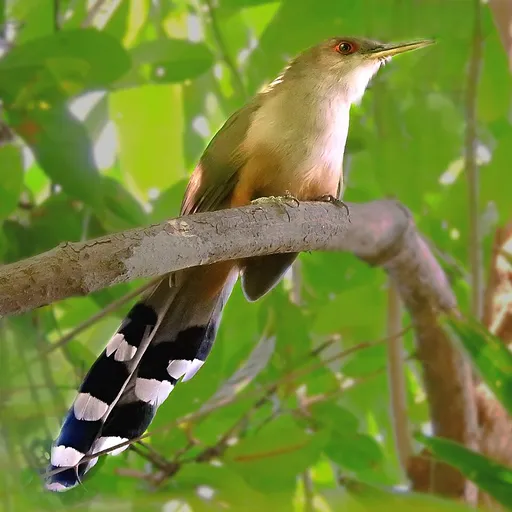
Puerto Rican Lizard Cuckoo
Coccyzus vieilloti
Least Concern
Overview
The Puerto Rican lizard cuckoo (Coccyzus vieilloti) is a species of bird in the cuckoo family Cuculidae, endemic to Puerto Rico. It is classified as Least Concern by the IUCN, with an estimated population of 2,200 to 3,000 mature individuals.
Identification
- Length of 40 to 48 cm, with the tail comprising approximately half of this total length.
- Adults possess entirely gray-brown upperparts, a gray throat and breast, and tawny belly and undertail coverts.
- Distinctive long decurved bill features a black maxilla and a yellow mandible with a black tip.
- A bare red eye ring surrounds the eye in adults, which is replaced by an orange-red ring in juveniles.
- The principal call is described as a harsh, emphatic series of 'ka-ka-ka-ka' notes that accelerate in tempo and volume over time.
Habitat
Found throughout the main island of Puerto Rico, this species inhabits a variety of forested landscapes including semi-open woodlands, dense montane forest, dry coastal forest, and swamp forest. It also utilises coffee plantations and brushy limestone hills, typically occurring between sea level and 900 m, though it can be found near the highest peaks.
Diet
The species forages for prey in the middle to upper layers of the forest, as well as in the understory and on the ground, hunting by stealth by climbing branches or walking. Its principal food consists of lizards, especially Anolis species, alongside adult and larval insects, eggs, and occasionally frogs.
Did you know?
Locally known as 'pájaro de lluvia' or 'rain bird', the species is believed by the local population to forecast rain through its calls. It is also referred to as 'pájaro bobo mayor' (greater cuckoo bird), highlighting its larger size compared to the common mangrove cuckoo.
Sources
- Wikipedia · CC BY-SA 4.0
- Wikidata · CC0 1.0