
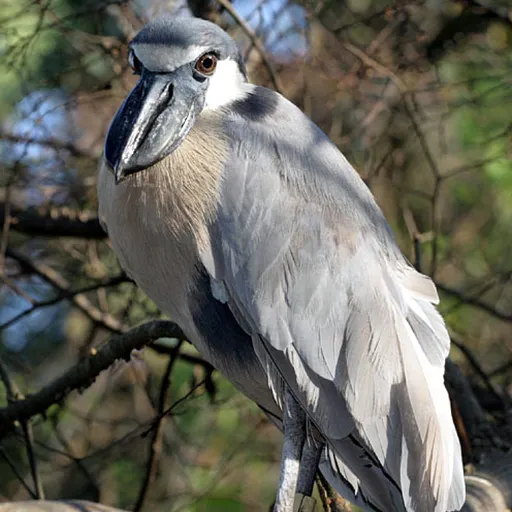
Boat-billed Heron
Cochlearius cochlearius
Least Concern
Overview
The boat-billed heron, Cochlearius cochlearius, is an atypical member of the heron family and the sole species in its genus. It is a nocturnal bird that inhabits mangrove swamps across Central and South America. The species is listed as Least Concern on the IUCN Red List.
Identification
- Approximately 54 cm long with pale grey to white plumage, chestnut abdomens, and black flanks.
- Possesses a massive, broad, scoop-like bill that is mainly black.
- Features a crest used for mate attraction, which is larger in males than in females.
- Adults have green-yellow legs, while nestlings share this trait with green-yellow skin and grey down feathers.
Habitat
Found in mangrove swamps, seasonal lagoons, and estuaries ranging from Mexico to Peru, Brazil, and northeastern Argentina. It is a non-migratory species that nests in mangrove trees, often breeding semi-colonially during the rainy season.
Diet
Feeds on small mammals, amphibians, invertebrates, and fish such as mullet, snook, and catfish. It forages at night in shallow water or under low-hanging branches, using its uniquely shaped bill to lunge at prey or scoop the water's surface.
Did you know?
The bill is hypothesised to be sensitive to touch, allowing the heron to feel for prey in dark, shallow, and muddy water. It refuses to feed in the presence of any light source, including daylight, moonlight, or artificial light.
Sources
- Wikipedia · CC BY-SA 4.0
- Wikidata · CC0 1.0