
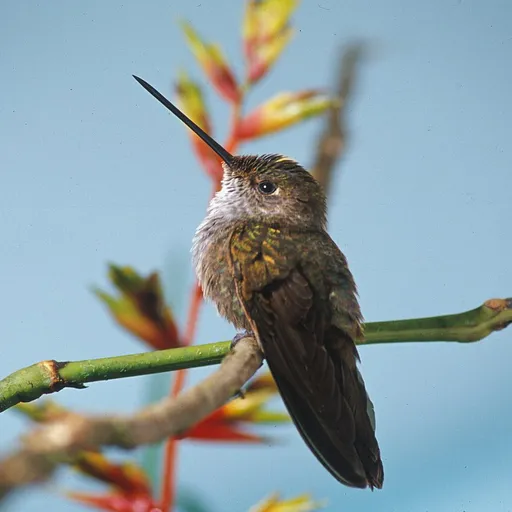
Bronzy Inca
Coeligena coeligena
Least Concern
Listen
XC250679 · Niels Krabbe · Zamora-Chinchipe: Reserva Tapichalaca, near Q. Cristopher Parson, Ecuador · CC BY-SA 4.0
Overview
The bronzy inca is a species of hummingbird found in the Andes of South America. It is the drabbest member of its genus and is currently assessed as being of Least Concern on the IUCN Red List.
Identification
- Approximately 14 cm long, with males weighing around 7.3 g and females around 6.2 g.
- Primarily dark bronzy brown with a maroon sheen above and greenish lower back; the forked tail is bronze.
- Features a white spot behind the eye, with white spots and dusky gray streaks on the throat and chest.
- Possesses a long, straight, black bill, often with some yellow at the base of the mandible in males.
Habitat
This species primarily inhabits the edges of humid pre-montane forests, though it also occurs in open landscapes with scattered trees and coffee plantations. Its elevation range is between 1,500 and 2,600 m, distributed across the Andes of Bolivia, Colombia, Ecuador, Peru, and Venezuela.
Diet
The bronzy inca forages for nectar by trap-lining, visiting a circuit of a wide variety of flowering plants. It seldom feeds above the mid-story of the forest but has been observed in the canopy. It also captures small arthropods by hawking and hover-gleaning.
Did you know?
It readily accepts some human-altered landscapes, meaning that deforestation does not appear to be a major threat to the species. Its song is described as a continuous series of single, rather sweet 'tseet' notes.
Sources
- Wikipedia · CC BY-SA 4.0
- Wikidata · CC0 1.0