
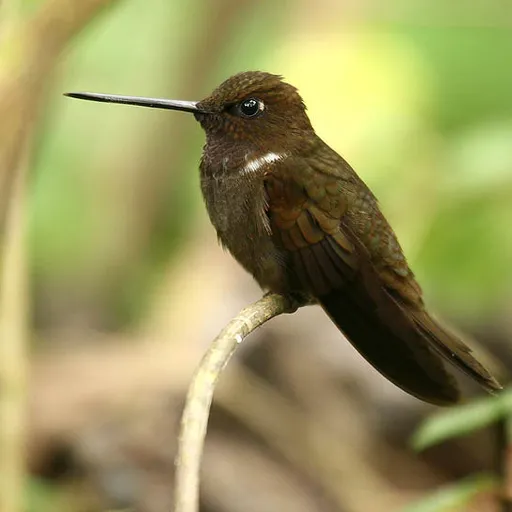
Brown Inca
Coeligena wilsoni
Least Concern
Overview
The brown inca (Coeligena wilsoni) is a small species of hummingbird found in the Pacific slopes of the Andes in Colombia and Ecuador. Classified as Least Concern by the IUCN, the species is considered uncommon to locally common, though its population is believed to be decreasing due to habitat loss.
Identification
- About 11 to 13 cm long with a long, straight, black bill and a distinctive white spot behind the eye.
- Males feature reddish bronze upperparts, a greenish olive lower back, and a bronzy forked tail; their underparts are dull brown with an amethyst gorget and white breast patches.
- Females resemble males but possess a longer bill, a smaller gorget, and a less forked tail, while the song consists of a repeated three-note phrase: 'tsip-tzreeew-tzrew'.
Habitat
Found on the Pacific slope of the Andes from Colombia's Chocó Department south to Ecuador's Loja Province, this species most commonly inhabits the edges of cloudforest and the forest interior. It generally ranges in elevation from 700 to 1,900 m, though it is most common below 1,300 m and has been recorded as high as 2,400 m.
Diet
The brown inca forages for nectar by trap-lining a circuit of various flowering plants in the low forest understory, including genera such as Psammisia, Macleania, Cavendishia, and Fuchsia. It supplements this diet by gleaning small arthropods from vegetation and occasionally capturing them by hawking.
Did you know?
The species' scientific name, wilsoni, commemorates the American naturalist Thomas Bellerby Wilson.
Sources
- Wikipedia · CC BY-SA 4.0
- Wikidata · CC0 1.0