
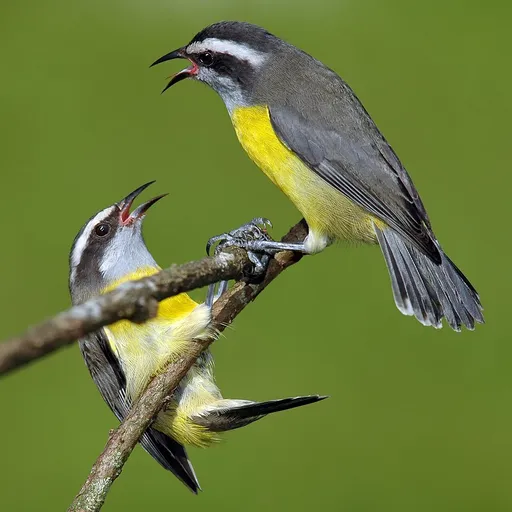
Bananaquit
Coereba flaveola
Least Concern
Listen
XC1027722 · Gean Carlo Valdés · Islas secas, Panama · CC0 1.0
Overview
The bananaquit (Coereba flaveola) is a small, active passerine bird belonging to the tanager family Thraupidae. It is a nectarivore found throughout the warmer parts of the Americas and is generally common across its range.
Identification
- Length ranges from 10 to 13 cm, with most subspecies displaying dark grey upperparts, black crowns and head sides, a prominent white eyestripe, and yellow chest, belly, and rump.
- Possesses a slender, curved bill adapted for taking nectar and a unique paddle-shaped tongue with an extremely long section.
- Sexes are visually alike, though juveniles appear duller and may have partially yellow eyebrows and throats.
Habitat
Resident in tropical South America north to southern Mexico and the Caribbean, though it is absent from Cuba and rare in deserts and dense forests. It thrives in a wide variety of open to semi-open habitats, including gardens and parks, at altitudes below 2,000 m.
Diet
Primarily a nectarivore that also consumes fruits such as berries, mistletoe fruits, and ripe bananas, as well as small insects and arthropods like ants, flies, and spiders. It perches to feed and sometimes pierces flowers from the side to rob nectar without pollinating the plant.
Did you know?
The bananaquit is known by the nickname 'sugar bird' due to its strong affinity for granular sugar in bowls or feeders. It has a remarkable ability to adjust to human environments, often building spherical nests with side entrances in artificial objects such as lampshades and garden trellises.
Sources
- Wikipedia · CC BY-SA 4.0
- Wikidata · CC0 1.0