
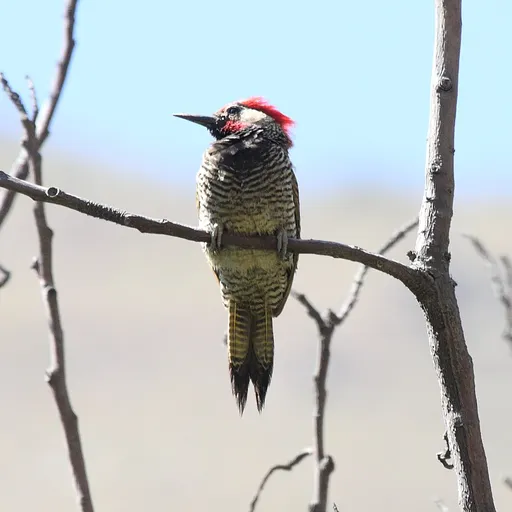
Black-necked Woodpecker
Colaptes atricollis
Least Concern
Overview
The black-necked woodpecker, also known as the black-necked flicker (Colaptes atricollis), is a species of bird in the family Picidae. It is endemic to Peru, where it inhabits a variety of semi-arid to arid landscapes.
Identification
- Measures 26 to 27 cm in length with bronze-green upperparts marked by narrow blackish bars, a black breast, and pale yellow underparts with black bars.
- Males possess dark gray foreheads and red hindcrowns, while females have red only on the hindcrown and blackish malar stripes.
- Features a longish black bill with a paler base, brown to chestnut-brown irises, and green-gray legs.
- Produces a loud, clear 'wic' call in a long series, along with alarm calls such as 'peah' and 'chypp'.
Habitat
Found on both the western and eastern slopes of the Peruvian Andes, the species occupies semi-arid to arid environments including drier cloud forest, montane scrublands with cacti, desert scrublands, and deciduous woodlands. It also frequents riparian woodlands, orchards, plantations, and gardens, ranging in elevation from 500 m to 4,300 m depending on the subspecies.
Diet
The bird feeds almost entirely on adult ants, their larvae, and pupae. It usually forages singly or in pairs at any level from the ground to the treetops, capturing food mostly by gleaning and probing.
Did you know?
Nest holes have been documented in a diverse range of locations, including trees, cacti, utility poles, and dry river banks.
Sources
- Wikipedia · CC BY-SA 4.0
- Wikidata · CC0 1.0