
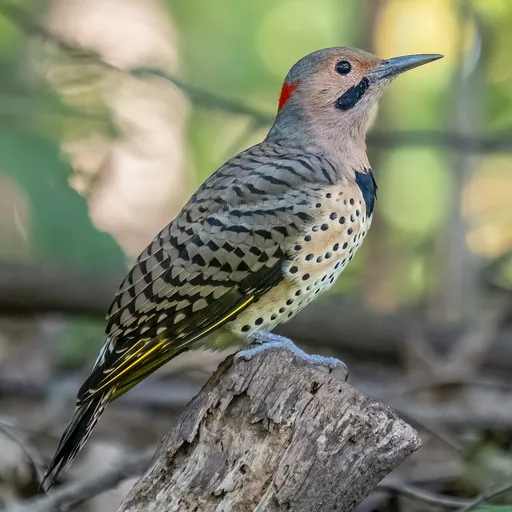
Northern Flicker
Colaptes auratus
Least Concern
Listen
XC389891 · Leonardo Guzman Hernandez · Arteaga, Coahuila de Zaragoza, Mexico · CC BY-SA 4.0
Overview
The northern flicker, or common flicker, is a medium-sized bird of the woodpecker family native to most of North America, parts of Central America, Cuba, and the Cayman Islands. It is one of the few woodpecker species that migrates, with over 100 common names recorded, many of which imitate its calls.
Identification
- Adults are brown with black bars on the back and wings, featuring a necklace-like black patch on the upper breast and a beige lower breast with black spots.
- Males possess a black mustachial stripe in eastern ranges or a red one in western ranges, whereas females lack this stripe.
- The tail is dark on top, transitioning to a conspicuous white rump visible in flight.
- The species is identified by a sustained laugh call (ki ki ki ki) and constant knocking on trees or metal objects to declare territory.
Habitat
The northern flicker inhabits open environments near trees, such as woodlands, forest edges, yards, and parks, including mountain forests in the western United States up to the tree line. They are cavity nesters that typically excavate holes in trees, though they may use posts, birdhouses, or old burrows left by belted kingfishers and sand martins.
Diet
Unlike most woodpeckers, northern flickers frequently feed on the ground, probing with their beaks and sometimes catching insects in flight. Their diet consists primarily of insects, particularly ants, which can account for 45% of their intake, alongside other invertebrates, fruits, berries, seeds, and nuts.
Did you know?
Northern flickers exhibit a behavior known as anting, in which they apply formic acid from ants to their feathers to assist in preening and remain free of parasites.
Sources
- Wikipedia · CC BY-SA 4.0
- Wikidata · CC0 1.0