
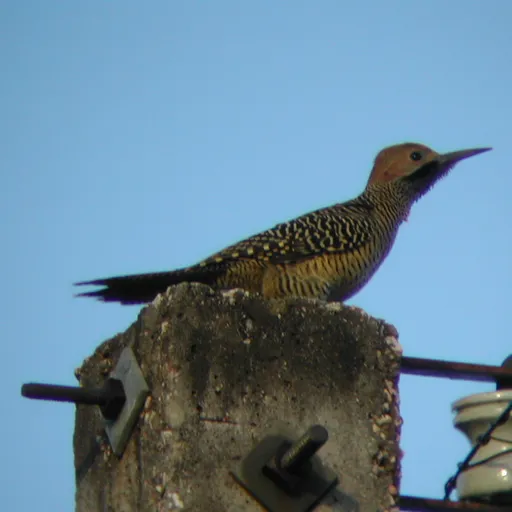
Fernandina's Flicker
Colaptes fernandinae
Endangered
Overview
Fernandina's flicker, also known as the Cuban flicker, is a medium-sized woodpecker in the family Picidae. Endemic to Cuba, it is classified as Endangered and is one of the most threatened woodpecker species globally.
Identification
- Medium-sized woodpecker measuring 14–15 in (36–38 cm) in length.
- Males possess a buffy cinnamon crown with fine black streaking and a distinctive black malar stripe; females have a heavily streaked black malar instead.
- Underparts are pale yellowish-buff with dark brown barring, while underwings are yellow and visible in flight.
- Vocalisations include a repeated wricka, a loud pic-pic-pic slower and lower-pitched than that of the northern flicker, and a nasal ch-ch-ch during breeding.
Habitat
Restricted to Cuba, the species inhabits lowland open-palm savannahs, dry forests, pastures, and swampy forests. It is closely associated with palm trees, particularly Sabal palmetto and the royal palm (Roystonea regia), and requires standing dead palms for nesting. Currently found in isolated locations across nine provinces, with the largest population in Zapata Swamp.
Diet
Primarily feeds on ants, but also consumes other insects, worms, grubs, and seeds. It forages on the ground using its strong bill to probe and flick aside leaf litter, and also feeds on termites found in both live and dead palms.
Did you know?
Fernandina's flicker often takes over nest holes started by the more aggressive West Indian woodpecker, driving off the original owners to finish the excavation and move in. This behaviour places it in direct conflict with a species that is also known to prey on the flicker's eggs and chicks.
Sources
- Wikipedia · CC BY-SA 4.0
- Wikidata · CC0 1.0