
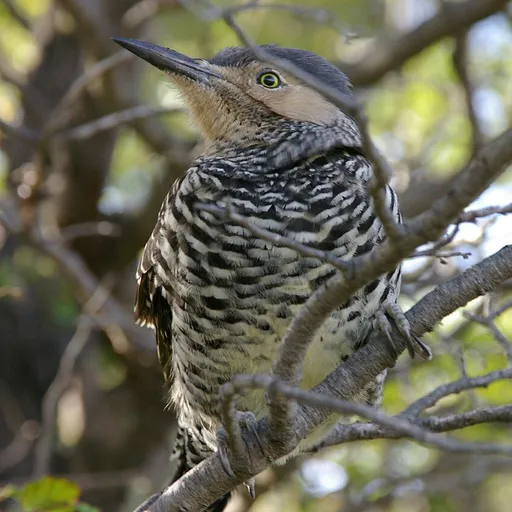
Chilean Flicker
Colaptes pitius
Least Concern
Overview
The Chilean flicker (Colaptes pitius) is a species of woodpecker found in central and southern Chile and adjacent southwestern Argentina. Assessed as Least Concern by the IUCN, it is considered rather common across its range and inhabits temperate and Mediterranean climate zones.
Identification
- Approximately 30 cm in length, with blackish brown upperparts marked by narrow white to buff-white bars and a white rump.
- Underparts are whitish with wide blackish brown bars on the breast; males have a dark slate gray crown with buffish malar spots, while females have a plain buffish malar area.
- Possesses a longish black bill, whitish to yellowish irises, and gray to green-gray legs.
- Vocalisations include a long 'wic wic wic' series, a whistled variable 'kwee', and a 'week-a, week-a'.
Habitat
Found in central and southern Chile from the Coquimbo Region to central Magallanes Region and in adjacent southwestern Argentina between Neuquén and Santa Cruz provinces. It favours semi-open to open landscapes such as forest edges, open woodlands, riparian woodland, tree plantations, and scrublands. Elevation ranges mostly between 600 and 1,000 m, though the bird can be found near sea level in winter.
Diet
Feeds almost entirely on adult ants, their larvae, and pupae, foraging usually on the ground close to trees. It moves by hopping, poking, digging, and sweeping aside debris, and will investigate fallen logs and stumps but rarely forages in trees. Foraging typically occurs in family groups.
Did you know?
The Chilean flicker excavates nest cavities in dead trees or snags, and sometimes in earthen banks, with a clutch size of four to six eggs during its October to December breeding season. It is believed to be highly territorial, although details regarding incubation periods and parental care remain unknown.
Sources
- Wikipedia · CC BY-SA 4.0
- Wikidata · CC0 1.0