
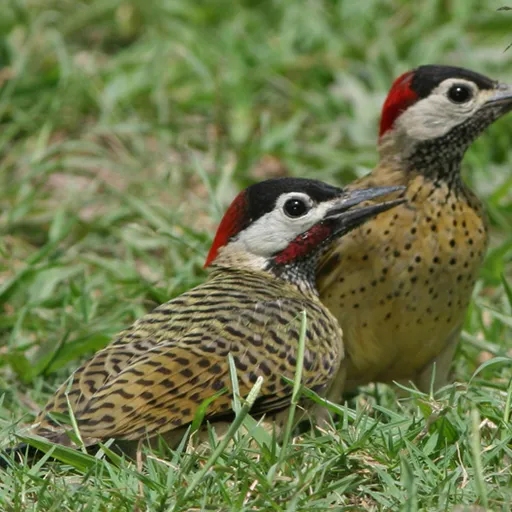
Spot-breasted Woodpecker
Colaptes punctigula
Least Concern
Listen
XC719869 · Hugo Oliveros-Salas · Baranoa, Atlantico, Colombia · CC0 1.0
Overview
The spot-breasted woodpecker, also known as the spot-breasted flicker, is a species in the subfamily Picinae of the woodpecker family Picidae. It is found in Panama and most mainland South American countries, excluding Argentina, Chile, Paraguay, and Uruguay, where it is considered rare in Panama but fairly common elsewhere.
Identification
- Adults measure 18 to 21 cm in length and weigh 50 to 79 g.
- Males of the nominate subspecies have a black forehead and forecrown with a red hindcrown and nape, while females have red only on the back of the crown.
- Upperparts are bronze-green with brownish black bars, and underparts are dull olive-yellow with reddish tinges and small black spots on the breast and flanks.
- The bill is short and blackish, the iris is rufous brown, and the legs are greenish gray, sometimes with a yellowish tinge.
Habitat
The species inhabits a wide variety of humid lowland landscapes, preferring sparse woodlands to dense ones, and occurs in rainforest, deciduous and gallery forest, várzea, mangroves, llanos, and palm savannas. It ranges from eastern Panama to the Amazon Basin in South America, generally found at elevations up to 600 m in Venezuela, 1,500 m in Colombia, and up to 1,600 m in Ecuador.
Diet
The spot-breasted woodpecker feeds almost entirely on adult ants, their larvae, and their pupae. It usually forages in pairs or family groups at any height from the ground to the forest's midlevel, capturing food by gleaning, probing, and sweeping aside litter on the ground.
Did you know?
Both sexes excavate the nest cavity, usually in a living or dead tree, but sometimes in a fence post. The bird possesses a large vocal repertoire that includes high-pitched nasal wha calls, peek notes in alarm, and low soft pee-ya calls during intimate pair meetings.
Sources
- Wikipedia · CC BY-SA 4.0
- Wikidata · CC0 1.0