
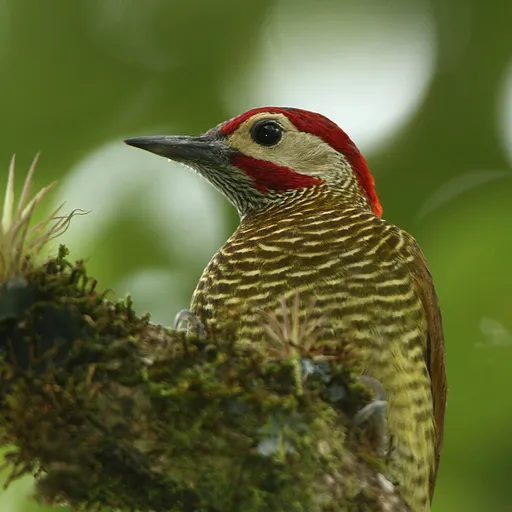
Golden-olive Woodpecker
Colaptes rubiginosus
Least Concern
Listen
XC250691 · Niels Krabbe · Zamora-Chinchipe: left bank Río Numpatakaime (C. Plateado trail camp 1), Ecuador · CC BY-SA 4.0
Overview
The golden-olive woodpecker (Colaptes rubiginosus) is a species of bird in the family Picidae. It is classified as a species of Least Concern by the IUCN, with an extremely large range that extends from Mexico south and east through Panama to most of mainland South America.
Identification
- Length of 18 to 23 cm with mostly green upperparts that have a bronze tinge, and paler, dark olive-barred rump and uppertail coverts.
- Underparts are pale buffy yellow with blackish olive bars that are closest together on the chest.
- Medium-length bill is slaty gray to black, with deep dull red irises and gray to olive-gray legs.
- Song is described as a protracted rising rattling trill, accompanied by various calls such as a loud, clear 'dree' or a 'liquid woick-woick-woick'.
Habitat
The species inhabits a wide variety of landscapes ranging from dry tropical thornscrubs to humid rainforests, including cloudforests, oak-pine woodland, and mangroves. It is frequently found along forest edges, in scattered trees within clearings, and in shade-grown coffee plantations. Elevation varies by region, ranging from near sea level up to 3,100 m in Colombia.
Diet
Foraging occurs from the mid-level to the canopy of large trees, where the bird pecks, hammers, probes, and prays to capture prey. Its primary diet consists of ants, termites, and wood-boring beetles and their larvae, with fruits and berries added rarely. A 2016 report noted that Müllerian bodies, which are growths produced by Cecropia plants to feed ants, are also part of its diet.
Did you know?
The specific epithet 'rubiginosus' is Latin for 'rusty', yet the bird is not predominantly that colour; instead, it features green upperparts with a bronze tinge. Some authors suggest that the golden-olive woodpecker and the grey-crowned woodpecker form a superspecies, though research indicates the golden-olive woodpecker is not monophyletic.
Sources
- Wikipedia · CC BY-SA 4.0
- Wikidata · CC0 1.0