
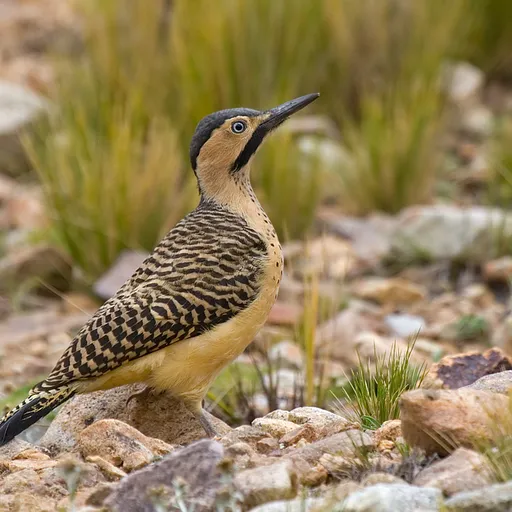
Andean Flicker
Colaptes rupicola
Least Concern
Listen
XC757729 · Belén y Diego · Valle Colorado, Valle Grande, Jujuy, Argentina · CC0 1.0
Overview
The Andean flicker (Colaptes rupicola) is a species of woodpecker found across the Andes mountain range in South America. It is a year-round resident in open, high-altitude landscapes, though it may descend to lower elevations when forced by snow and cold. The species is classified as Least Concern by the IUCN, with large and stable populations across its range in Argentina, Bolivia, Chile, Ecuador, and Peru.
Identification
- Approximately 32 cm in length, with a long black bill, lemon-yellow irises, and legs that may appear yellowish, greenish, or greyish-pink.
- Upperparts are barred with brown, light brown, and buffy white; underparts are whitish with a variable orange-buff wash on the breast and small blackish markings.
- Adult males of the nominate subspecies have a dark slate-grey head, occasionally with a hint of red on the hindneck, and a malar stripe with red-tipped feathers; females have an all-black malar stripe and no red on the hindneck.
- Vocalisations include loud, piercing 'kweeir' and 'tew-tew-tew' calls, along with a clear descending trill for long-distance communication.
Habitat
This bird inhabits open country such as páramo, puna, Polylepis woodland, and montane scrublands characterised by mixed rock, grass, and higher vegetation. It typically resides at elevations between 2,000 and 5,000 m, usually above 3,000 m, and uses rocks, cliffs, and trees as lookout points. Its range extends from Loja Province in Ecuador through central and southern Peru into northern Chile, western and southern Bolivia, and northwestern Argentina.
Diet
The Andean flicker forages almost entirely on the ground, often in groups of up to 10 birds, by dropping from vantage points to probe and dig in the soil. It sweeps away pebbles and debris to locate insects, including adult and larval beetles and large larvae such as those of butterflies.
Did you know?
Unlike most woodpeckers, the Andean flicker nests colonially, with 10 or more pairs living very close together and excavating cavities in earthen banks or soil on rock faces rather than in tree trunks.
Sources
- Wikipedia · CC BY-SA 4.0
- Wikidata · CC0 1.0