
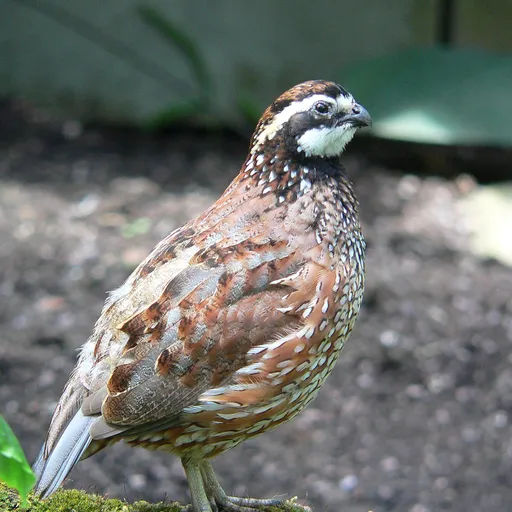
Northern Bobwhite
Colinus virginianus
Near Threatened
Overview
The northern bobwhite, or Virginia quail, is a ground-dwelling bird native to North America that has suffered an approximate 85% population decline since 1966. It is one of the most familiar quails in eastern North America, characterised by its secretive nature and distinct whistling call, and is currently rated as Near Threatened by the IUCN.
Identification
- Measures 24 to 28 cm in length with a short, curved, brown-black bill and the typical chunky, rounded shape of a quail.
- Sexually dimorphic with males featuring a white throat and brow stripe bordered by black, whereas the overall rufous plumage shows gray mottling on the wings, white scalloped stripes on the flanks, and black scallops on the whitish underparts.
- Emits a very recognisable clear whistle of "bob-WHITE" or "bob-bob-WHITE" that rises in pitch a full octave, alongside lisps, peeps, and rapid warning calls.
Habitat
Found year-round in agricultural fields, grasslands, open woodland areas, roadsides, and wood edges. Its range covers the southeastern United States, extending into eastern Mexico and Cuba, with various introduced populations across the Caribbean, Europe, Asia, and New Zealand.
Diet
Feeds on a diet of plant material and small invertebrates, including snails, ticks, grasshoppers, beetles, spiders, crickets, leafhoppers, seeds, wild berries, partridge peas, and cultivated grains. Forages on the ground in open areas that feature spots of taller vegetation.
Did you know?
The name "bobwhite" is an onomatopoeic derivation of the bird's characteristic whistling call. Despite its secretive behaviour, it is frequently the only quail in its range in eastern North America.
Sources
- Wikipedia · CC BY-SA 4.0
- Wikidata · CC0 1.0