
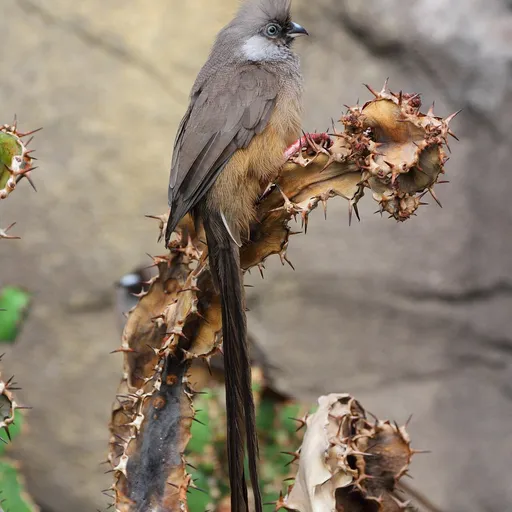
Speckled Mousebird
Colius striatus
Least Concern
Overview
The speckled mousebird (Colius striatus) is the largest species of mousebird and one of the most common in its range. It is distributed throughout most of Central, Eastern, and Southern Africa, where it is classified as Least Concern on the IUCN Red List.
Identification
- Approximately 35 cm long with a long tail that comprises about half of the total length.
- Dull-mousy brown plumage overall, including the back and head, which features a prominent crest.
- Black upper bill and pinkish lower bill; distinguished from the white-headed mousebird by the lack of a bare grey orbital patch.
- Emits a warbling 'tsu-tsu' call during flight, often accompanied by a 'tisk-tisk' alarm call.
Habitat
Found across a broad range from Cameroon to Eritrea and south to South Africa, this species prefers open bushveld, savanna, and open woodlands. It avoids rainforests and more arid areas, but thrives in tangled thickets and is frequently observed as a common 'backyard bird' in urban gardens and orchards.
Diet
The speckled mousebird is a frugivore that feeds on fruits, berries, leaves, seeds, and nectar. It is a conspicuously social bird that feeds in groups and occasionally swallows pebbles to help grind up vegetation for digestion.
Did you know?
Upon nightfall, these birds roost in very tight groups of around 20 individuals and can become torpid on cold nights. Although this state of torpor makes them vulnerable, the large size of the group is apparently effective enough to deter most nocturnal predators.
Sources
- Wikipedia · CC BY-SA 4.0
- Wikidata · CC0 1.0