
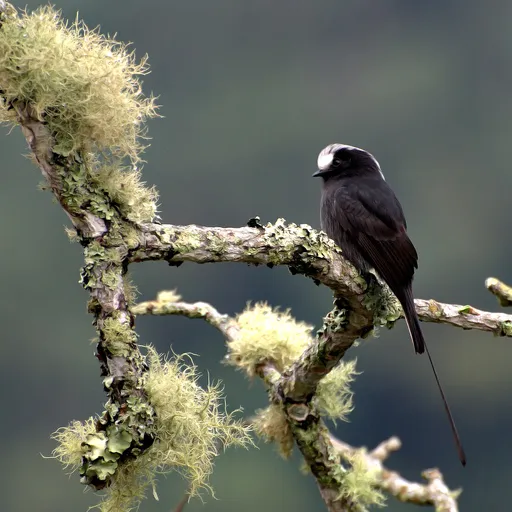
Long-tailed Tyrant
Colonia colonus
Least Concern
Listen
XC250703 · Niels Krabbe · Zamora-Chinchipe: 'Cabañas Yankuam' 2 km S Las Orchideas, Nangaritza Valley, Ecuador · CC BY-SA 4.0
Overview
The long-tailed tyrant (Colonia colonus) is a species of bird in the family Tyrannidae, the tyrant flycatchers. It is found in Central America from Honduras to Panama and in every mainland South American country except Chile and Uruguay. The IUCN has assessed the species as being of Least Concern with a stable population.
Identification
- Adult males of the nominate subspecies are mostly dull black with a white forehead and forecrown, a whitish rump, and a grayish black belly, while females are paler and grayer with a mottled white belly.
- Males measure 23 to 28 cm and females 18 to 22 cm, excluding the elongated central tail feathers which can extend up to 13 cm beyond the others and have somewhat widened tips.
- All subspecies possess a short, wide, black bill, black legs and feet, and a dark iris.
- Vocalisations include a soft, rising call described as 'sweeE' or 'weé-uw', a musical humming 'druu' while whipping the tail, and a sharp, sibilant chip in interactions.
Habitat
The species inhabits semi-open landscapes in tropical and lower subtropical zones, including edges of humid evergreen forest and woodland, gallery forest, early successional forest, and plantations with standing snags. Its distribution is disjunct across Central and South America, ranging in elevation from sea level to up to 2,300 m in Peru, though it is mostly below 1,200 m in South America. It is a year-round resident in almost its entire range.
Diet
The long-tailed tyrant feeds on insects and specialises in stingless bees in some areas such as Costa Rica. It primarily forages in pairs or small family groups, perching high on snags or open branches and hawking prey in mid-air. After capturing prey, the bird often returns to the same perch, which is frequently in the same tree as its nest.
Did you know?
The nest is constructed as a mat of leaf rachises in the bottom of a cavity, such as an old woodpecker hole or rotted knothole, and can be located anywhere from 8 to 30 m above the ground. Pairs actively defend this territory, particularly against intrusion by other cavity-nesting species.
Sources
- Wikipedia · CC BY-SA 4.0
- Wikidata · CC0 1.0