
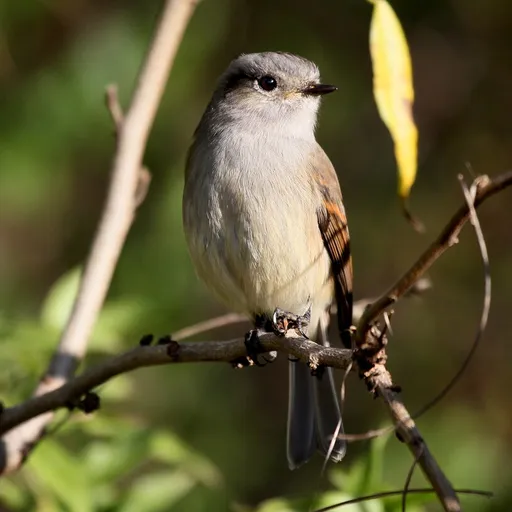
Patagonian Tyrant
Colorhamphus parvirostris
Least Concern
Overview
The Patagonian tyrant (Colorhamphus parvirostris) is a small tyrant flycatcher found in Argentina and Chile. It is the sole member of its genus and is assessed as being of Least Concern by the IUCN, although it may face future threats from habitat loss.
Identification
- Measures 12 to 13 cm in length with a mostly gray head featuring a darker brownish-gray crown and a blackish streak behind the eye.
- Upperparts are olive-brown with blackish-brown wings that display two cinnamon wing bars on the coverts; the tail is blackish-brown.
- Throat and underparts are grayish with a yellowish wash on the belly and flanks, while the bill, legs, and feet are entirely black.
- Song is described as a long, descending whistle repeated every three to four seconds, sometimes mixed with shorter whistles.
Habitat
Found from north-central Chile's Coquimbo Region and southern Argentina's Neuquén and Río Negro provinces south to Tierra del Fuego. During the breeding season, it almost exclusively inhabits Nothofagus forest, but in the non-breeding season, it utilises denser, humid forest types, urban areas, parks, and gardens. It ranges in elevation from sea level to 2,000 m, with a single record at 2,700 m.
Diet
Feeds primarily on insects, supplemented by other arthropods and small fruits such as those of maytén and leñadura. It forages mostly singly or in pairs, though it occasionally joins mixed-species feeding flocks. It captures prey in mid-air via sallies from perches, but also takes food from vegetation and the ground.
Did you know?
The species is a nearly complete migrant that vacates most of its breeding range for the austral winter, remaining in the northern parts of the range only in small numbers. It is uncommon in its breeding grounds and considered extremely rare in the far southern part of its range.
Sources
- Wikipedia · CC BY-SA 4.0
- Wikidata · CC0 1.0