
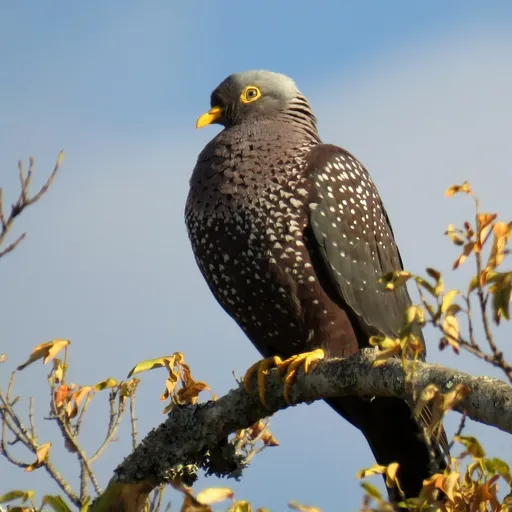
African Olive Pigeon
Columba arquatrix
Least Concern
Overview
The African olive pigeon, also known as the Rameron pigeon (Columba arquatrix), is a large pigeon found as a resident breeder in much of eastern and southern Africa. It is locally common but restricted to specific high-altitude habitats, making it a monotypic species with little variation across its range.
Identification
- Large pigeon, 37 to 42 cm in length and 300 to 450 g in weight.
- Adult males have maroon backs and wings with heavy white spotting on the shoulders and underparts; females are similar but duller.
- Distinctive grey head with yellow patches around the eye and a yellow bill.
- Juveniles appear dark brown with pale wing fringes and dull greenish-yellow bare parts; adults in flight appear very dark.
Habitat
Occupies cool, moist forest canopies primarily above 1,400 m, though it can be found as low as 700 m in certain areas. It also utilises mountain fynbos, second-growth vegetation, clearings, and agricultural land where it is not persecuted. Its range extends from Ethiopia to the Cape, with isolated populations in western Angola and the Arabian Peninsula.
Diet
Feeds on fruit and berries, predominantly picking them in the canopy but also consuming fallen fruit and insects such as caterpillars. In southern regions, it favours the fruit of the invasive bugweed (Solanum mauritianum). Birds may travel considerable distances from roosts to feeding areas, with non-breeding individuals forming flocks.
Did you know?
This species exhibits geophagy, consuming clay soil with a basic pH and high sodium content to supplement minerals and buffer the acidity of its fruit-heavy diet.
Sources
- Wikipedia · CC BY-SA 4.0
- Wikidata · CC0 1.0