
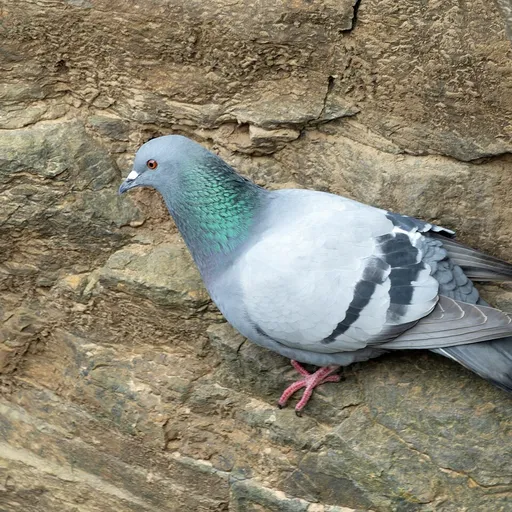
Rock Dove
Columba livia
Least Concern
Listen
XC1136258 · Sonothèque ADVL · Arrondissement of Avranches (near Le Mont-Saint-Michel), Manche, Normandie, France · CC0 1.0
Overview
The rock dove (Columba livia), also known as the common or rock pigeon, is a member of the family Columbidae and the wild ancestor of all domesticated pigeons. It is classified as a least-concern species by the IUCN and is widely abundant across global habitats.
Identification
- Adults measure 30 to 35 cm in length with a wingspan of 62 to 68 cm, featuring a dark bluish-grey head, neck, and chest with glossy greenish to reddish-purple iridescence.
- The plumage is uniformly pale grey with two distinct black bars on each wing, while the white lower back serves as a primary field identification marker.
- The tail displays a black terminal band with white margins on the outer webbing, and the bird has red-brown irises, a grey-black bill with a small off-white cere, and red to pink feet.
- When circling overhead, the white underwings are conspicuous, and the flight includes frequent gliding with wings held in a pronounced V shape.
- The call is a soft, slightly wavering coo described as 'crruoo-u', with a grunt-like 'oorhh' used as an alarm call.
Habitat
Originating in Southern Europe, North Africa, and Western Asia, the species naturally resides in open and semi-open environments such as rock formations, cliff faces, caves, and canyons where it can forage on the ground. It avoids dense vegetation and, in its domesticated and feral forms, has a very large global range introduced aboard European ships from 1603 onwards.
Diet
Rock doves are omnivorous but primarily prefer plant matter, feeding chiefly on fruit and grains. They forage on the ground either individually or in flocks, with social feeding roles dividing into 'producers' that scout for food and 'scroungers' that follow them to feed on discovered sources.
Did you know?
Rock doves possess a form of 'footedness' similar to human handedness, as their foot stamping behaviour is done with a specific foot first, although the purpose of this deliberate action remains unclear.
Sources
- Wikipedia · CC BY-SA 4.0
- Wikidata · CC0 1.0