
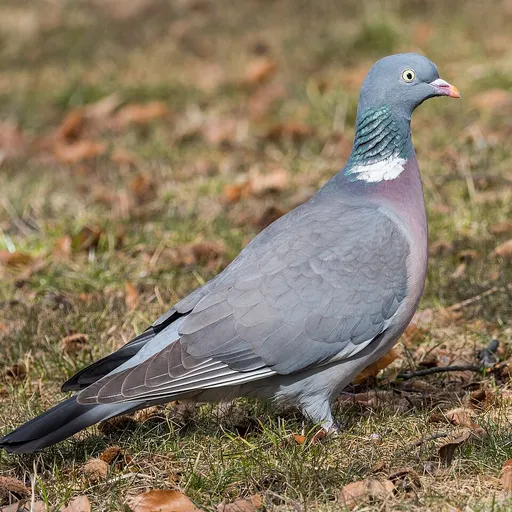
Common Wood Pigeon
Columba palumbus
Least Concern
Listen
XC1107845 · Sonothèque ADVL · Courtils, Manche, Normandy, France · CC0 1.0
Overview
The common wood pigeon (Columba palumbus) is a large pigeon native to the western Palearctic that has been classified as Least Concern by the IUCN Red List. Although considered an agricultural pest and extensively hunted across its range, these activities do not appear to significantly impact population numbers.
Identification
- A large bird measuring 38–44.5 cm in length with a wingspan of 68–80 cm, distinguished by white markings on the neck and wing against a mostly grey plumage.
- Features a pinkish breast and a series of green and white patches on the neck, with pale yellow eyes.
- Juveniles lack the white neck patches and appear lighter in grey tone with a greyer bill until the markings develop fully at six to eight months.
- Produces a monotonous five-syllable cooing call, traditionally interpreted as the mnemonic "Take two cows, Teddy".
Habitat
Native to the western Palearctic, the species ranges from Europe and western Asia to northwest Africa, Iran, and parts of Central Asia. It acts as a migrant in colder northern and eastern regions but remains a resident in southern and western Europe, including Great Britain where it is frequently found in parks, gardens, and urban areas.
Diet
Possessing a flexible diet, it feeds primarily on plant material such as cereals, young shoots, seedlings, and fruits including acorns and figs. In autumn, it also consumes buds, while occasionally eating larvae, ants, and small worms. It requires open water for drinking and bathing.
Did you know?
The traditional mnemonic for its call, "Take two cows, Teddy," begins and ends mid-phrase as the full sequence is "two cows Teddy, take two cows Teddy, take two cows Teddy, take". Wood pigeons in urban areas can become exceptionally tame, allowing close contact such as stroking and petting from individuals they trust.
Sources
- Wikipedia · CC BY-SA 4.0
- Wikidata · CC0 1.0