
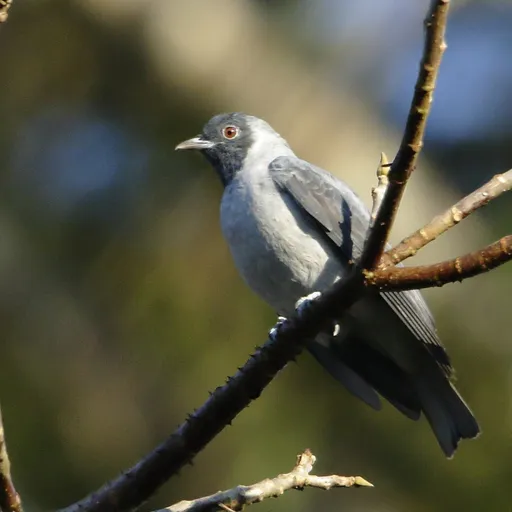
Black-faced Cotinga
Conioptilon mcilhennyi
Least Concern
Overview
The black-faced cotinga (Conioptilon mcilhennyi) is a species of bird in the family Cotingidae, classified as Least Concern by the IUCN. It is the sole member of its genus and is found across parts of South America, including Bolivia, Brazil, and Peru.
Identification
- Plumage: Adult males feature a mostly black head and throat with a distinct white crescent behind the ear coverts; upperparts are dark gray, while the breast is lighter gray fading to white on the lower belly and undertail coverts.
- Size: Measures 23 to 25 cm (9.1 to 9.8 in) in length, with weights recorded between 81 to 89 g.
- Physical Features: Possesses a dark grayish-brown bill with a slight hook on the tip, dark reddish-brown irises, and dark olive-gray legs.
- Unique Trait: Almost unique among passerines, its unfeathered parts have white powder down, and the upper surfaces of its wings and tail are also powdery.
- Voice: Vocalisations include a short, barked 'puh', a quiet descending 'coww', and a squeaky, rising 'huuEEE?' that glides up to three notes higher.
Habitat
This species inhabits humid forests, particularly swampy or seasonally flooded areas around lakes and rivers, with a preference for várzea in Brazil though it also occurs in terra firme and burned forest. Its range covers eastern Peru (Ucayali, Madre de Dios, Cuzco), far western Brazil's Acre state, and far northern Bolivia's Pando Department. It is mostly found at elevations below 300 m, rarely reaching 450 m.
Diet
The black-faced cotinga feeds mostly on fruit, supplementing its diet with insects and possibly flowers. It forages by plucking fruit while briefly hovering after a sally from a perch, typically acting singly or in pairs. Although it does not join mixed-species flocks, it often feeds with other species in fruiting trees, especially larger Ficus figs.
Did you know?
The species is almost unique among passerine birds for having white powder down on its unfeathered parts, with powdery surfaces on its wings and tail. Its common name references the specific epithet mcilhennyi, which was assigned to honour John S. McIlhenny for sponsoring the Louisiana State University 1964-65 Peruvian Expedition that obtained the first specimens.
Sources
- Wikipedia · CC BY-SA 4.0
- Wikidata · CC0 1.0