
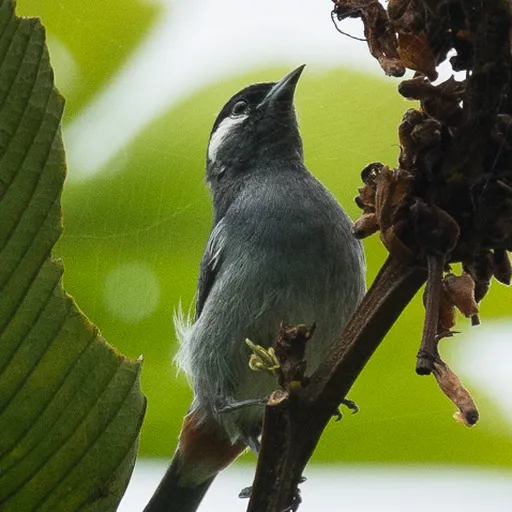
White-eared Conebill
Conirostrum leucogenys
Least Concern
Overview
The white-eared conebill (Conirostrum leucogenys) is a small bird species in the family Thraupidae. It was first described by Frédéric de Lafresnaye in 1852 and is currently classified as Least Concern on the IUCN Red List.
Identification
- Males feature a blue back, wings, and tail with light blue underparts and a rufous undertail covert.
- Distinctive markings include a black crown, face, and lores contrasted by a white cheek.
- Females are more subtly coloured with a lighter blue back and crown, olive primaries, and a yellow breast, belly, and face.
- Both sexes possess silver bills, brown eyes, and greyish-black legs.
Habitat
This species inhabits subtropical or tropical moist lowland forests and heavily degraded former forest. Its range extends across South and Central America, specifically in Colombia, Panama, and Venezuela.
Diet
Like other conebills, it mainly eats insects, foraging usually in the canopies of trees. It has also been known to join mixed-species flocks, although not as frequently as relatives such as the blue-backed conebill.
Did you know?
The bird's taxonomic history reflects its physical traits, having been originally described by de Lafresnaye as a dacnis and later moved through the defunct genus Ateleodacnis before being placed in its current genus, Conirostrum.
Sources
- Wikipedia · CC BY-SA 4.0
- Wikidata · CC0 1.0