
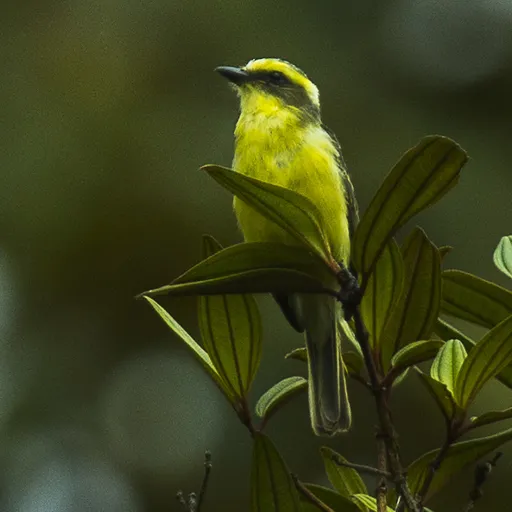
Lemon-browed Flycatcher
Conopias cinchoneti
Least Concern
Listen
XC248874 · Niels Krabbe · Napo: 'Cabañas San Isidro', 1-2 km SW Cosanga, Ecuador · CC BY-SA 4.0
Overview
The lemon-browed flycatcher (Conopias cinchoneti) is a species of tyrant flycatcher found in the Andes of northern and central South America. It currently holds a Least Concern status on the IUCN Red List, with a stable population despite its highly disjunct distribution.
Identification
- Plumage: Olive-green crown and upperparts with a bright greyish yellow forehead and a wide pale yellow supercilium that wraps almost entirely around the nape; bright yellow underparts with an olive tinge on the sides of the breast.
- Size: Approximately 15.5 to 16 cm long.
- Bill and Legs: Possesses a longish black bill and blackish legs and feet.
- Vocalization: Distinctive, high-pitched nasal, twittering and petulant-sounding calls described as 'whee-ee-ee-ee, wheedidididídí-dí' or 'pa'treeer-pa'treeer-pa'treeer'.
Habitat
This species inhabits a variety of semi-open landscapes, including small forest clearings, larger openings with tall trees, and the edges of cloud forest. It is distributed across Colombia, Ecuador, Peru, Venezuela, and possibly Bolivia, with altitudes ranging from 800 to 2,150 m depending on the country.
Diet
The lemon-browed flycatcher feeds on insects and small fruits, typically foraging in pairs, small family groups, or occasionally mixed-species flocks. It perches high in the open canopy and captures prey with short sallies to new perches, gleaning from vegetation, or less often via brief hovers.
Did you know?
The few known nests of the lemon-browed flycatcher were constructed inside old oropendola or cacique nests, indicating a unique form of nest-site reuse.
Sources
- Wikipedia · CC BY-SA 4.0
- Wikidata · CC0 1.0