
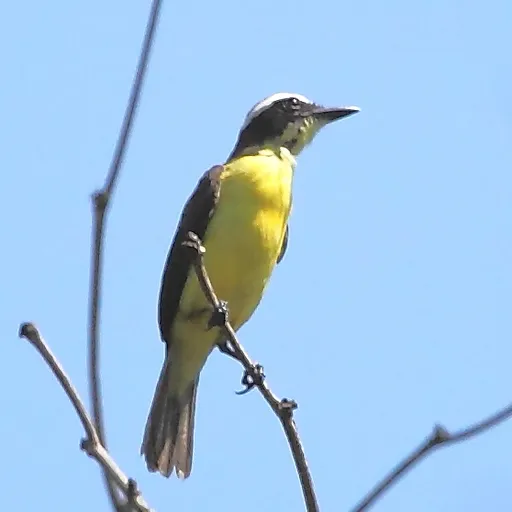
Yellow-throated Flycatcher
Conopias parvus
Least Concern
Overview
The yellow-throated flycatcher (Conopias parvus) is a species of tyrant flycatcher found across parts of South America. It is currently classified as Least Concern on the IUCN Red List, although its population is believed to be decreasing.
Identification
- Measures 15 to 16.5 cm in length with a weight of approximately 21 g.
- Features a black to dark sooty brownish crown and face with a partially hidden lemon-yellow patch in the crown centre and a bright canary-yellow throat and underparts.
- Displays a prominent white supercilium that widens behind the eye and wraps around the nape, contrasting with greyish olive-green upperparts.
- Produces a loud, rhythmic call described as a trilled or ringing 'quee-le-le' or 'weedle-de-wee' repeated many times.
Habitat
This species inhabits the canopy and edges of humid to wet evergreen forests, mature secondary forest, and occasionally taller trees in clearings. Its range extends from extreme northeastern Ecuador through Venezuela, the Guianas, and into Brazil north of the Amazon River, with possibly unconfirmed records in Bolivia. Elevational distribution varies by region, reaching up to 1,300 m in Brazil and Venezuela but only 200 m in Ecuador.
Diet
The bird feeds primarily on insects and small fruits, foraging typically in pairs or small family groups. It perches high in the canopy, often at the very top of trees, and captures prey by gleaning, hovering during sallies, or hawking insects in mid-air.
Did you know?
The species has a complicated taxonomic history, having been originally described as Pitangus parvus and later treated as a subspecies of the white-ringed flycatcher before being recognised again as a full species in the early twenty-first century.
Sources
- Wikipedia · CC BY-SA 4.0
- Wikidata · CC0 1.0