
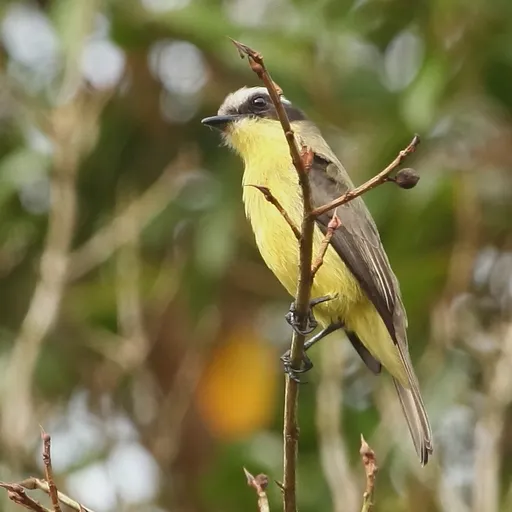
Three-striped Flycatcher
Conopias trivirgatus
Least Concern
Overview
The three-striped flycatcher (Conopias trivirgatus) is a species of tyrant flycatcher found in South America. It is the smallest member of its genus and is classified as Least Concern by the IUCN, despite a decreasing population trend.
Identification
- Size: 13.5 to 14.5 cm (5.3 to 5.7 in) long.
- Plumage: Adults of the nominate subspecies have a dusky brown crown and face with a white supercilium that wraps around the nape, pale olive upperparts, and bright lemon-yellow underparts.
- Bill and legs: Possesses a long, thin, blackish bill and blackish legs and feet.
- Song: Calls include an abrasive, swiftly repeated jew or jeeuw, and in Peru, a low-pitched chu-burr duet.
Habitat
This species inhabits the canopy and edges of humid forest, primarily várzea, ranging in elevation from sea level up to 950 m in Venezuela. It has a disjunct distribution across parts of Brazil, Venezuela, Ecuador, Peru, Bolivia, and Argentina.
Diet
The three-striped flycatcher feeds on insects, typically foraging in pairs or small family groups and joining mixed-species feeding flocks. It perches high in the canopy, capturing prey by hawking in mid-air or making short sallies to snatch insects from vegetation.
Did you know?
The bird's scientific name was corrected in the early twenty-first century from trivirgata to trivirgatus because the genus Conopias was recognised as masculine, requiring the specific epithet to match that gender.
Sources
- Wikipedia · CC BY-SA 4.0
- Wikidata · CC0 1.0