
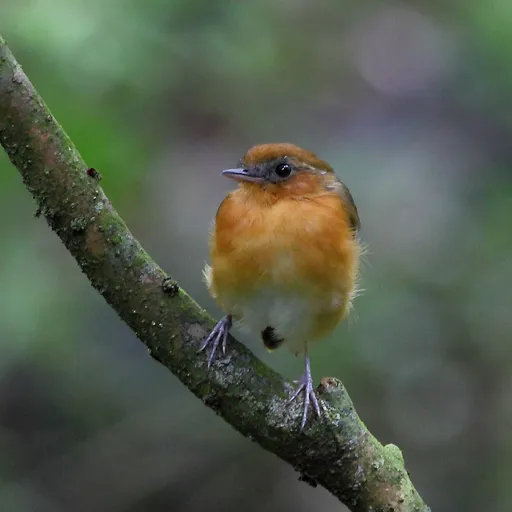
Ceara Gnateater
Conopophaga cearae
Near Threatened
Overview
The Ceará Gnateater (Conopophaga cearae) is a small passerine bird belonging to the gnateater family, Conopophagidae. It is currently classified as Near Threatened on the IUCN Red List and is endemic to a limited region in northeastern Brazil.
Identification
- Measures approximately 11.5 to 14 cm in length and weighs an average of 24.5 g.
- Features vivid orange or apricot plumage with a white belly patch and a bright eye line, distinguishing it from the dirtier-colored Rufous Gnateater.
- Produces a lower-pitched and slightly slower vocalization than the Rufous Gnateater, earning it the local name 'chupa-dente' or 'tooth-sucker' due to the sound of its vocalisations.
Habitat
This species inhabits the dense forest understory and bushes of isolated patches of Atlantic Forest at higher elevations in northeastern Brazil. Its range is restricted to the states of Ceará, Pernambuco, Paraíba, Rio Grande do Norte, and Alagoas.
Diet
As an insectivore, it forages close to the forest floor, usually perching on vertical branches to capture small arthropods and beetles. After capturing prey, it retreats to the safety of the dense underbrush and forages alone or with its mate, avoiding mixed groups unlike other members of its family.
Did you know?
The bird's local name, 'chupa-dente' or 'tooth-sucker', derives from the specific sound it produces when vocalising. A conservation project in July 2025 aimed to reintroduce the species to the Serra de Aratanha mountain range, where it was previously locally extinct.
Sources
- Wikipedia · CC BY-SA 4.0
- Wikidata · CC0 1.0