
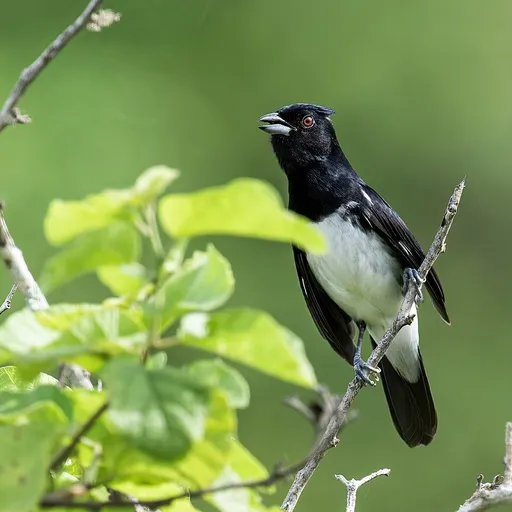
Black-and-white Tanager
Conothraupis speculigera
Least Concern
Listen
XC242461 · Niels Krabbe · Loja: Tambo Negro 10 km E Macará, Ecuador · CC BY-SA 4.0
Overview
The black-and-white tanager (Conothraupis speculigera) is a migratory bird in the family Thraupidae, primarily found in Ecuador and Peru. It is classified as Least Concern on the IUCN Red List, though its population is considered stable but threatened by habitat loss. The species exhibits significant sexual dimorphism, with males and females displaying distinct plumage patterns.
Identification
- Adult males feature a black head, throat, neck, upper breast, and back, with white underparts and gray sides.
- Females possess olive upperparts, a white throat with an olive-yellow tinge, and buff-white underparts, resembling juveniles.
- Both sexes have a thickish bluish-gray bill with a black tip, dark gray legs, and a red-brown iris.
- The song is a loud, repetitive liquid phrase described as 'chi-DONG chi-DONG chi-DONG', accompanied by a high, descending 'tee' call.
Habitat
Breeding in dry woodlands, forest, and scrublands in southwestern Ecuador and northwestern Peru, the species seeks areas of local rain. During the non-breeding season, it inhabits forest edges, open areas, rivers, and secondary forest in the Amazon Basin, ranging from Amazonian Peru into western Brazil. Elevation varies by region, from 500 to 1,700 m in Ecuador, up to 1,500 m in breeding Peru, and below 700 m in Amazonia.
Diet
The black-and-white tanager feeds mostly on insects and spiders, with smaller amounts of seeds included in its diet. Foraging occurs singly, in pairs, or in small groups that occasionally exceed 50 birds, typically taking place in the upper parts of trees.
Did you know?
The species' nest was first formally described in 2006 in Ecuador as an untidy, loosely woven cup made of sticks and leaf petioles, lined with fungal rhizomorphs. A second nest found in Peru in 2004 was constructed in a shrub of the family Urticaceae.
Sources
- Wikipedia · CC BY-SA 4.0
- Wikidata · CC0 1.0