
Cuban Pewee
Contopus caribaeus
Least Concern
Overview
The Cuban pewee, also known as the crescent-eyed pewee, is a small songbird in the tyrant flycatcher family found in Cuba and the Bahamas. It is classified as a species of Least Concern by the IUCN and is considered a common, year-round resident across its range.
Identification
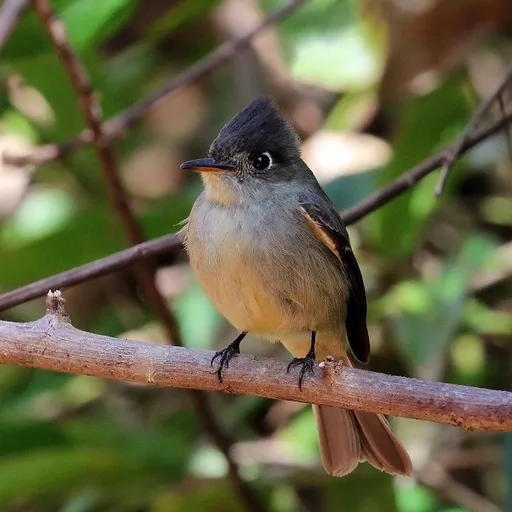
- Length of 15 to 16.5 cm with a dark olive-gray crown and a slight crest.
- A distinct whitish crescent marks the back of the eye on an otherwise olive-brown face.
- Wings are dusky brown with two faint pale wing bars, while the belly and undertail coverts are buffy mustard-yellow.
- Possesses a wide, flat bill with a black upper mandible and orange-yellow lower mandible, along with black legs and feet.
- The dawn song of the nominate subspecies consists of a high squeaky whistle described as "eeah, ooweeah".
Habitat
This species inhabits the interior and edges of broadleaf and pine forests, brushy scrublands, swampy areas, and tree plantations within tropical and upper tropical zones. Its range includes mainland Cuba and Isla de la Juventud, as well as several islands in the Bahamas such as Grand Bahama, New Providence, and Eleuthera. It is found from sea level to 1,800 m, though it is rarer above 1,000 m.
Diet
The Cuban pewee feeds primarily on insects and includes some fruit in its diet. It forages by sitting erect on an exposed perch low to the ground and capturing prey in mid-air with sallies, a method known as hawking. It typically returns to the same perch after a sally and shivers its tail upon landing.
Did you know?
The species was formerly treated as part of the Greater Antillean pewee but was separated in 1993 based on differences in vocalizations, plumage, and measurements. It is also noted for shivering its tail when landing on a perch after a hawking sally.
Sources
- Wikipedia · CC BY-SA 4.0
- Wikidata · CC0 1.0