
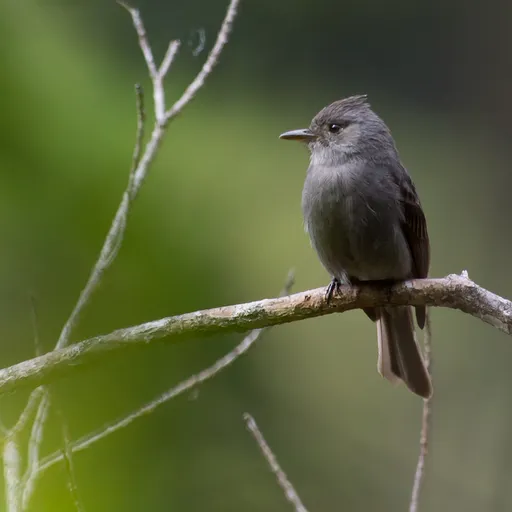
Smoke-colored Pewee
Contopus fumigatus
Least Concern
Listen
XC825809 · Rosa Elena Albornoz · Fila De Mariches (near Parroquia La Dolorita), Sucre, Miranda, Venezuela · CC0 1.0
Overview
The smoke-colored pewee, Contopus fumigatus, is a small tyrant flycatcher found across South America. It is characterised by its uniform dusky-grey plumage and a distinct head crest.
Identification
- Mature birds are 16–17 cm long with a uniform grey plumage, though the upper body and wing tips may be tinged with olive or pale brown.
- Features an orange bill with a black culmen and a slight crest on the head.
- Displays a range of calls, most commonly a loud "pip pip pip" and a clear, repeated "peeew" whistle.
- Juveniles are lighter and browner than adults, often showing a fringed buff of feathers at the nape.
Habitat
Native to Argentina, Bolivia, Brazil, Colombia, Ecuador, Guyana, Peru, and Venezuela, this species inhabits subtropical or tropical dry and moist montane forests, as well as heavily degraded former forests. Birds typically reside at elevations between 1000 and 2500m, avoiding flat lowlands, and are resident rather than migratory.
Diet
The smoke-colored pewee primarily consumes insects, obtaining them through sallying. This foraging technique involves catching prey in the air and returning to a perch to feed, often revisiting the same perch between feeding sessions.
Did you know?
Despite the scientific name Contopus fumigatus deriving from the Latin word fumus (smoke) to describe its color, the genus name Contopus actually originates from the Ancient Greek words for 'pole' and 'foot'.
Sources
- Wikipedia · CC BY-SA 4.0
- Wikidata · CC0 1.0