
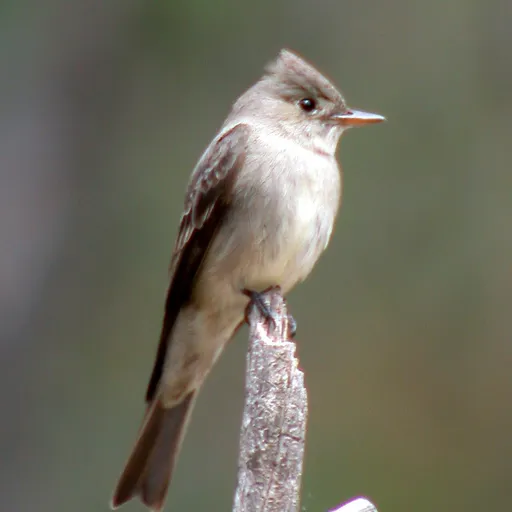
Greater Pewee
Contopus pertinax
Least Concern
Overview
The greater pewee (Contopus pertinax), formerly known as Coues's flycatcher, is a passerine bird in the family Tyrannidae. It is found from Arizona and New Mexico in the United States southwards through Mexico and Central America to Nicaragua.
Identification
- Length of 18 to 20 cm with a weight of approximately 22 to 36 g, featuring a spiky crest.
- Plain olive-gray head and upperparts, with a slightly lighter face and pale lores.
- Wings are dusky grayish brown with two faint wing bars created by grayish olive ends on the coverts.
- Breast and belly are buffy, while the throat and sides are olive-gray with a buffy yellowish tinge.
Habitat
The greater pewee primarily inhabits pine and pine-oak forest in subtropical and temperate zones, often found at elevations between 900 and 3,400 m. It has a disjunct distribution, with the nominate subspecies ranging from the south-western United States to the Isthmus of Tehuantepec and the minor subspecies occurring from east of the Isthmus through to northern Nicaragua.
Diet
The species feeds mostly on flying insects, capturing prey in mid-air by hawking from a dead branch near a treetop. During the non-breeding season, it adds other insects and some berries to its diet, often accompanying mixed-species feeding flocks.
Did you know?
The song of the nominate subspecies is a plaintive 'Ho-say ma-ree-ah', which gives rise to its Mexican Spanish name 'papamoscas José María'.
Sources
- Wikipedia · CC BY-SA 4.0
- Wikidata · CC0 1.0