
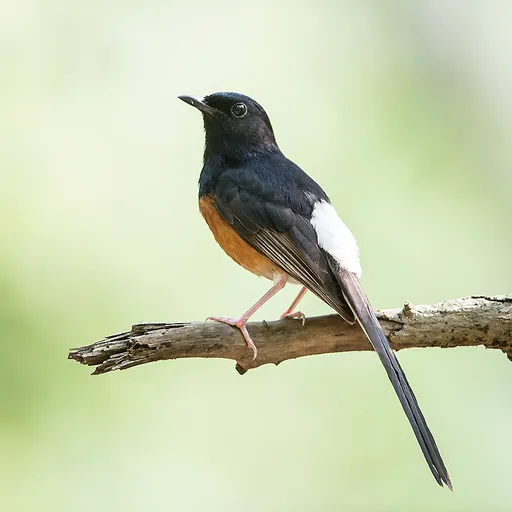
White-rumped Shama
Copsychus malabaricus
Least Concern
Overview
The white-rumped shama (Copsychus malabaricus) is a passerine bird in the Old World flycatcher family Muscicapidae, native to densely vegetated habitats in the Indian subcontinent and Southeast Asia. Its popularity as a cage bird and songster has led to its introduction to other regions.
Identification
- Males are glossy black with a chestnut belly and white feathers on the rump and outer tail; females are greyish-brown and typically shorter.
- Both sexes have a black bill and pink feet; juveniles are greyish-brown with a blotchy or spotted chest.
- The bird typically weighs between 28 and 34 g and measures around 23–28 cm in length.
- The voice is rich, melodious, loud, and clear, often mimicking other birds, with a 'Tck' call used in alarm or foraging.
Habitat
Native to scrub and secondary forests in South and Southeast Asia, the bird favours dense undergrowth, especially in bamboo forests. It has been introduced to Hawaii, where it is common in valley forests or on the ridges of the southern Koolaus, and to Taiwan, where it is considered an invasive species.
Diet
In the wild, the bird feeds on insects, whereas in captivity it may be fed on boiled, dried legumes with egg yolk and raw meat.
Did you know?
The earliest known recording of bird song was made of an individual of this species in 1889 by Ludwig Koch, who recorded his pet shama using an Edison wax cylinder.
Sources
- Wikipedia · CC BY-SA 4.0
- Wikidata · CC0 1.0