
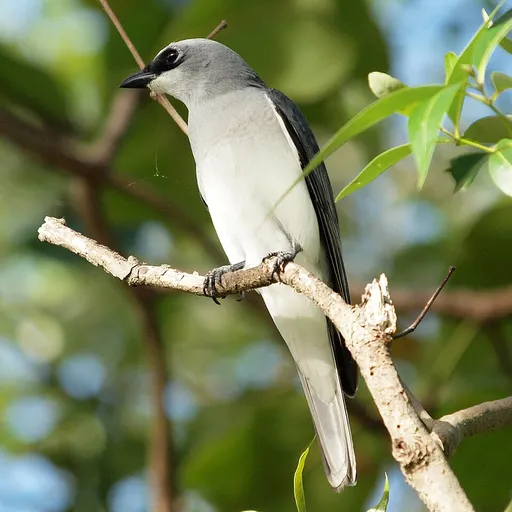
White-bellied Cuckooshrike
Coracina papuensis
Least Concern
Overview
The white-bellied cuckooshrike (Coracina papuensis) is a small passerine bird belonging to the family Campephagidae. It is a widespread and relatively common species found across parts of Australia, Indonesia, Papua New Guinea, and the Solomon Islands.
Identification
- A short black mask extending from the beak to the eyes, accented by a fine white rear eye-ring.
- Plumage is pale blue-grey on the head and upperparts, with the belly ranging from white to grey; some subspecies, such as C. p. robusta, exhibit a dark morph with extensive black plumage on the neck and chest.
- Adults measure between 22 and 29 cm in length and weigh 55–80 g, appearing more compact than the similar black-faced cuckooshrike.
- Call includes a peevish 'kissik kissik' or 'quiseek', as well as a weak, squealing 'whee-eeyu' that has been likened to the voice of a parrot.
Habitat
This species inhabits a diverse array of environments, including savanna, woodlands, rainforest, mangroves, and suburban gardens, while generally preferring lower-lying and forested habitats below 800 m above sea level. Its range extends throughout tropical northern and eastern Australia, as well as across the Moluccas, New Guinea, and the Solomon Islands.
Diet
The diet primarily consists of larger insects such as dragonflies, cockroaches, and beetles, supplemented by spiders, fruit, and seeds. Foraging is typically conducted by gleaning through tree foliage in single, pairs, or small groups, though sallying and ground foraging also occur.
Did you know?
The white-bellied cuckooshrike is often spotted by its distinct undulating flight pattern, where it gains altitude by flapping its wings before holding them stiffly downward to glide. Despite its name, the belly plumage can range from white to grey depending on the specific region and subspecies.
Sources
- Wikipedia · CC BY-SA 4.0
- Wikidata · CC0 1.0