
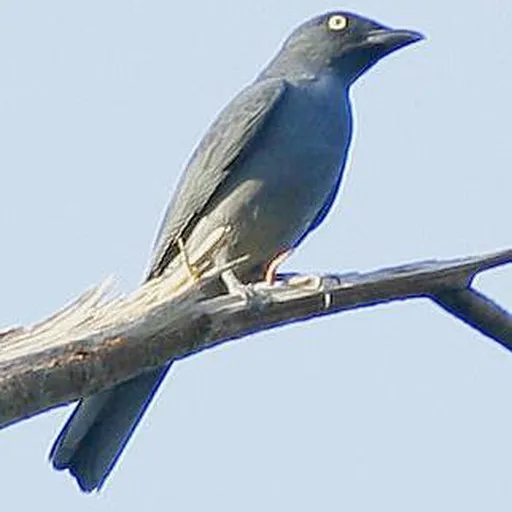
Bar-bellied Cuckooshrike
Coracina striata
Least Concern
Overview
The bar-bellied cuckooshrike (Coracina striata) is a species of bird in the family Campephagidae. It is assessed by the IUCN as a species of least concern, although its global population appears to be decreasing slowly due to habitat destruction.
Identification
- Length ranges from 24–32 cm (9.4–12.6 in), with plumage and size varying among subspecies.
- In the Thai-Malay Peninsula, Sumatra, and Borneo, males have grey upperparts with barring on the rump and lower-tail coverts, while females have barred underparts up to the lower breast.
- Juveniles in certain regions exhibit brown, white, and black upperparts with white underparts bearing black bars.
- Vocalisations include a harsh klee kleep, a whistling keeuk-keeuk, sic sic sic, tliu k'liu, and a whinnying kliukliukliu.
Habitat
Found in the Thai-Malay Peninsula, Sumatra, Borneo, the Philippines, and associated small islands such as the Kangean and Natuna Islands, this species inhabits low-elevation back-mangrove forest, dry forest, freshwater swamp forest, secondary forest, and occasionally scrubs or plantations. It became locally extinct in Singapore around the late 1960s.
Diet
This cuckooshrike primarily feeds on insects, including caterpillars, mantises, and dragonflies, and also consumes figs. It typically forages in small groups or as part of mixed-species foraging flocks alongside other cuckooshrikes.
Did you know?
Although the original 1775 specimen described by Buffon was believed to have come from New Guinea, the species does not actually occur there, and its true type locality has been designated as the island of Luzon in the Philippines.
Sources
- Wikipedia · CC BY-SA 4.0
- Wikidata · CC0 1.0