
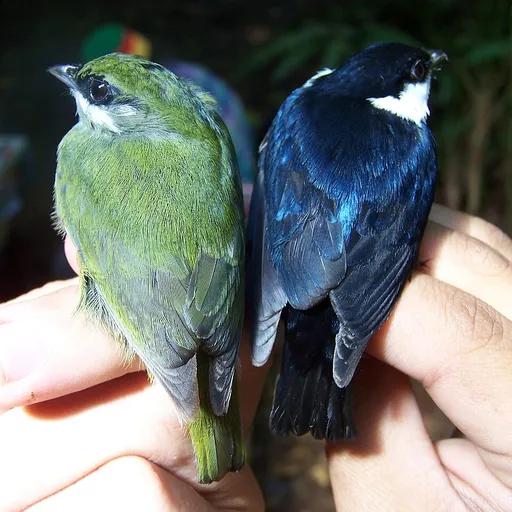
White-ruffed Manakin
Corapipo altera
Overview
The white-ruffed manakin (Corapipo altera) is a small passerine bird in the manakin family, native to the tropical New World. It is a resident breeder found in eastern Honduras to northwestern Colombia, typically inhabiting wet forests and adjacent clearings.
Identification
- Size and shape: A compact, short-tailed bird measuring approximately 10 cm (4 in) in length, with a flat, wide bill and dark legs.
- Male plumage: Mostly glossy blue-black with a distinctive white erectile ruff on the throat and sides of the neck; wings feature a very short outer primary.
- Female plumage: Olive-green with a greyish throat.
- Song and display: Males perform complex lek displays involving 'butterfly' flights, accompanied by high, thin 'seeuw-seeuw' calls and a 'flap-chee-wah' sequence during dives and jumps.
Habitat
This species primarily inhabits wet forest, often restricted to primary forest but also occupying adjacent clearings and tall secondary growth. It breeds in the foothills and middle elevations of Central America, mainly between 400 and 600 m on the Caribbean slope and up to 1500 m on the Pacific slopes, with some populations migrating to lower elevations during the wet season.
Diet
The white-ruffed manakin feeds low in the trees on fruit, spiders, and insects, plucking them from foliage in flight. Males are highly frugivorous, with over 90% of their diet consisting of fruit, particularly small berries from the Melastomataceae family, while females consume more arthropods during the breeding season.
Did you know?
Males exhibit a complex mating ritual where they perform high-speed dives to mossy logs followed by a jump and about-face, making a 'flap-chee-wah' sound, before copulating with a female who has selected them by landing on the log.